Showing posts with label Digest. Show all posts

Tuesday, August 1, 2023

How Accepting the Church as Petrine Transformed Me

 The stunning realization transformed me miraculously, turning me from a “Church rebel” into a passionate “Church defender”.

 I will place the key of the House of David on Eliakim's shoulder; when he opens, no one shall shut, when he shuts, no one shall open (Is 22:22).

I will give you the keys to the kingdom of heaven. Whatever you bind on earth shall be bound in heaven; and whatever you loose on earth shall be loosed in heaven (Mt 16:19).

I was dumbfounded when the above two verses from Isaiah and Matthew respectively were first paired up for comparison and the deeper meanings revealed by Dr. Scott Hahn in one of his earlier cassette-tape series on biblical studies. Born a rebel who customarily disliked any establishments and institutions, particularly the Catholic Church, I found Dr. Hahn’s comparison and insights fascinating and convincing. 

Through Isaiah’s prophecy, God promises to give “the key of the House of David” to Eliakim, which signifies authority and power. He will represent the king and act as his governor or prime minister, if you will, governing the kingdom of David. More importantly, the authority given to Eliakim is complete and unreserved: “when he opens, no one shall shut, when he shuts, no one shall open”.

What is really striking is that Isaiah’s prophetic words that made Eliakim the leader governing the kingdom of David on behalf of the king were adopted almost word by word by Jesus when he made Peter (originally named “Simon”) the first leader of his Church, which is already the seed and the beginning of the kingdom of God on earth (LG 5). In response to Simon Peter’s confession that he was “the Christ, the Son of the living God”, Jesus said, “I will give you [Peter] the keys to the kingdom of heaven. Whatever you bind on earth shall be bound in heaven; and whatever you loose on earth shall be loosed in heaven” (Mt 16:19).

By adopting Isaiah’s prophetic words intentionally, Jesus is making three very significant points: 

1.     Jesus makes Peter the Sovereign Pontiff of his Church - Just as God made Eliakim the representative and governor of the kingdom of David by giving him the key of the house of David, he is making Simon Peter the vicar of his Church on earth by giving him the keys to the kingdom of heaven. As the Church on earth is already the seed and the beginning of that kingdom, Peter represents Jesus to govern his kingdom of heaven here on earth (LG 5). This is what the Catholics mean when they say the Church of Christ is Petrine.

2.    The Sovereign Pontiff’s authority over the Church is complete and unrestricted  Just as Eliakim’s governing authority was complete and unrestricted – “when he opens, no one shall shut, when he shuts, no one shall open” – the governing authority of Peter and his successors is also complete and unrestricted. Thus: “Whatever you bind on earth shall be bound in heaven; and whatever you loose on earth shall be loosed in heaven”.

3.     The Church is built on Peter and his successors - And so I say to you, you are Peter, and upon this rock I will build my church” (Mt 16:18). In response to Simon calling him “Christos” (in Greek, which means “Messiah”), Jesus calls Simon “Petros” (in Greek, which means “rock”) (16:16,18). The pun – “Christos” and “Petros” – is not incidental; it is a powerful way to make clear Jesus’ intention to build his Church on the person of Peter, the leader of the 12 apostles; the person he is addressing directly and for whom he has just given a new name. It’s “on this rock” - on this “petra” (the word for a physical object in Greek, same meaning as “Petros” which refers to a person) - that he will build his Church. 

As I studied this topic more and more, I found myself captivated by the magisterial position of the Catholic Church that the only divinely instituted “Church of Christ, which in the Creed we profess to be one, holy, catholic and apostolic, was entrusted [by Christ] to Peter’s pastoral care [and] is governed by the successor of Peter and by the bishops in communion with him” (LG 8). The stunning realization transformed me miraculously, turning me from a “Church rebel” into a passionate “Church defender”. 

Little did I know that this change in me, drastic and unbelievable as it was, was only the beginning of a spiritual conversion of epic proportions. When it was all said and done, my world view, moral values, and personal life, particularly my marriage and family, had gone through a clear break with the past. It’s fair to say, the world as I knew it had turned completely upside down. And it’s all for good. For the first time, I truly understood what St. Peter meant when he said, “For you had gone astray like sheep, but you have now returned to the shepherd and guardian of your souls” (1 Peter 2:25). If my first encounter with the Isaiah 22:22 vs. Matthew 16:19 comparison was like a hurricane that shook me to the core of my being, the full force of its tailwinds can still be felt on encountering it again in this Sunday’s readings.


Friday, March 31, 2023

The Jerusalem Heartache

The Good News that they’ve heard and the best meal that they’ve ever had have permeated their whole being with great joy and a compelling sense of mission. They can’t wait to return to Jerusalem to serve the Lord and help people entangled in the Jerusalem heartache.

 “Were not our hearts burning within us while he spoke to us on the way and opened the Scriptures to us?" the two disciples wondered out loud after a mysterious encounter with the risen Christ on their way from Jerusalem to Emmaus (Luke 24:32).  

For people who have the blessing of encountering Christ through the Scriptures, the way from Jerusalem to Emmaus is a powerful spiritual journey they traverse often. It is heavenly to hear the divinely inspired word directly from the mouth of Christ who, as the Word of God, embodies the sacred Scriptures, and is the only “one in heaven or on earth or under the earth” capable of opening the sacred scroll (cf. Rev 5:3-5). They hear, as Pope Benedict XVI articulated it with so much eloquence, “a polyphonic hymn”, “a single word expressed in multiple ways”, a “symphony of many voices in which the one word is spoken” (Verbum Domini 7). No wonder the two disciples found their hearts “burning” during the mysterious encounter!

Jerusalem is a city of dejection and danger for the two disciples. Their conviction that they have finally found the Messiah in Jesus the Nazarene has just been crushed and shattered into pieces when he died like a criminal on the cross. And the Roman authority and the Sanhedrin are aggressively hunting down his followers. But now they are hearing that he might still be alive, and that his tomb was found empty. What’s really going on? It’s nothing but heartache, confusion, and fear.

Unfortunately, the ”Jerusalem heartache” that haunted the two disciples is in many ways also haunting all of us. Every descendent of Adam and Eve living in a world order deprived of its original innocence and holiness because of our first parents’ unbelief and disobedience must experience it again and again. Sometimes, it seems there’s just no breaking away from Jerusalem!

But the loving Father will not leave us hopeless and despondent. For every heartache or confusion or fear that we experience in the Jerusalem of our hearts, there is always hope that a joy or enlightenment or comfort is out there waiting to be found - if only we have the courage, the will, and the resilience to turn our back on Jerusalem and set out for Emmaus, as the two disciples did. Where is Emmaus? A Judean village of uncertain location according to Ignatius Catholic Study Bible. But it doesn’t matter where it is really. What matters is that somewhere out there, away from Jerusalem, there is hope, there is an opportunity to start anew, there is Emmaus.

On their journey in search of hope and comfort, they encounter the risen Lord, who enlightens them and makes them understand that it is “necessary that the Christ should suffer these things and enter into his glory” (Lk 24:26). How does Jesus do that? Using the sacred Scriptures. “Beginning with Moses and all the prophets, he interpreted to them what referred to him” (Lk 24:27). In other words, he gives them a quick overview of the whole salvation history, how it progresses from Moses and the prophets to Christ; from the law as our disciplinarian to faith as fulfillment and justification; from, in a word, the Old Covenant to the New (cf. Gal 3:24-25). What a rich and profound scriptural discourse that must have been!

As rich as the scriptural discourse is, Jesus does not stop there. He goes on to share a meal with them. What happens next is a sequence of actions reminiscent of what he did at the Last Supper: “he took bread, said the blessing, broke it, and gave it to them” (Lk 24:30, 22:19). Clearly, this is no ordinary meal. It is the Eucharistic liturgy! It is only then that the “[disciples’] eyes were opened, and they recognized him” (Lk 24:31) The road to Emmaus is in fact a Mass liturgy in which Jesus gives himself to the Church in word and in Sacrament (the Eucharist); it is the miniature of the Mass liturgy, beginning with the liturgy of the Word and ending with the liturgy of the Eucharist. The Church’s response to Christ’s self-emptying, as shown by the two disciples, is thanksgiving expressed in the form of “heart burning” on hearing the word and “eyes opened and see Jesus” on receiving the Eucharist.

But it’s at this point, just when the disciples have heard the word and received the Eucharist,  that the most amazing thing happens: “So they set out at once and returned to Jerusalem” (Lk 24:33)! They can’t wait to return to Jerusalem, the city of heartache and danger, the awful place that they’ve tried to run away from. Why? The Good News that they’ve heard and the best meal that they’ve ever had have permeated their whole being with great joy and a compelling sense of mission. They can’t wait to return to Jerusalem to serve the Lord and help people entangled in the Jerusalem heartache. So must we do the same after hearing the word of God and receiving the Eucharist at Mass. This is what the Church asks of us when the priest concludes the Mass celebration with this simple commissioning: Go forth, the Mass is ended; “Ite Missa est” (cf. Pope BXVI, Sacramentum Caritatis 51).


Thursday, March 2, 2023

The Romance at Jacob’s Well

The symbolism in this Sunday’s gospel is dense, its meanings rich and multi-layered. This comes as no surprise to the readers, knowing that the scriptural passage is selected from the Gospel of John, whose author is widely acclaimed by all exegetes, both ancient and contemporary, for his artistry of allegorical  expression and imagery. 

The scene depicting Jesus’ encounter with the Samaritan woman at Jacob’s well immediately brings to mind three classic marital arrangements in the Pentateuch that took place in similar settings: the encounter of Abraham’s servant with Rebekah at a spring that ended with her marriage to Isaac; Jacob’s encounter with Rachel at a well, whom he eventually married; Moses’ encounter with his future wife, Zipporah, at a well in Midian (Gen 24:10-67, Gen 29:1-30, Ex 2:15-21; Ignatius Catholic Study Bible Jn 4:6). 

Drawing on the nuptial meaning of these ancient marital encounters and using the special backdrop of the well – the place of courtship in the Pentateuch - as the common denominator, John sees in Jesus’ encounter with the Samaritan woman at the Jacob’s well a romance leading to a new and everlasting marital relationship. The God who throughout the Old Testament scriptures has been persistent in wanting to win over the heart of his beloved people, Israel, reveals his Trinitarian Self in his Son, the incarnate Jesus, in the New Testament. At the Jacob’s well, Jesus, the divine Bridegroom in search of believers to be his covenant bride, speaks prophetically in the sweet and irresistible language of love to court his beloved bride as embodied by the Samaritan woman. 

The courtship is apparently a fruitful one. The love story continues to unfold with the woman departing in a hurry. In her rush to leave, she abandons even her water jar – an important tool for her livelihood. She can’t wait to tell her people about this charming Lover that she has just encountered: “Come see a man who told me everything I have done. Could he possibly be the Christ?” (John 4:29). She calls Jesus “Christ” or “Messiah”!  A stone-cold conversation that began with the Samaritan woman calling Jesus “a Jew” and “sir” has turned into an affable, heart-melting, life-changing dialogue of the lovers. She has fallen in love with the divine Bridegroom head over heels. She can’t wait to proclaim the good news to her community and to the world, if necessary.

The Samaritan woman is in fact an image of infidelity and faithlessness. The fall of the northern kingdom of Israel to Assyria in the 8th century and the resettlement of foreign peoples in the region had forced the remaining Israelites to intermarry with the pagans. Over time they gradually adopted the pagan way of worship and religious practices. They became the Samaritans who were considered “defiled” by the Jews. The enmity between the two peoples remained even in Jesus’ day. The “five husbands” that the Samaritan woman had refers to the pagan deities and idols of Samaria (Ignatius Catholic Study Bible Jn 4:18). 

But the Samaritan woman is an image not only of Samaria, but also of Israel, Judah, and indeed you and me. The divine Bridegroom’s courtship is not reserved for the Samaritan woman alone. It’s also extended to you and me. Let’s retrace the myriad footsteps of our lives. When was it that Jesus met you at the well for the first time? What was it like? Can you recall the sweet dialogue of love and how it touched your heart? Did you proclaim the good news to your neighbors the way the Samaritan woman did? If yes, how? The author of this reflection, for one, is doing just that!


Sunday, November 13, 2022

Scriptural Hyperbole or Understatement? You Tell Me!

 “The desert and the parched land will exult; the steppe will rejoice and bloom… Here is your God, he comes with vindication; with divine recompense he comes to save you. Then will the eyes of the blind be opened, the ears of the deaf be cleared; then will the lame leap like a stag, then the tongue of the mute will sing” (Is 35:1,4-6). 

When younger, I just didn’t know what to make of scriptural passages like this. So much exaggeration! “Do people really believe this stuff? What is God thinking? Why do passages like this appear everywhere in the scriptures under His mighty inspiration, especially in the Old Testament books? Does He think we must necessarily accept His every word even if it’s clearly ridiculous?” I wondered aloud. After many years of hearing them at the Mass, my resentment gradually turned into indifference; my protest became a muffled groan. “O, well”, I would shrug my shoulders and sigh, “just another example of scriptural hyperbole!” 

Then something happened to me personally in the early nineties that changed everything. It was as though a bulb in my head had suddenly lighted up, or a veil that had covered my eyes for so many years since my birth had been lifted. Suddenly – miraculously - I began to understand God’s word! Like the Bride (the Church) in Song of Songs, to whom the fragrance of her Groom (God) “is like perfume poured out”, I found myself savoring every little word He said in the scriptures as though I could never have enough (SS 1:3). I wanted to find out more what He really meant, what the word in its original language referred to, what the immediate and overall contexts were, how the historical setting underlying those words would help me understand better the real message, etc. Slowly but surely, I came to realize that what I used to see as “exaggerations” or scriptural hyperboles were in fact gross understatements! 

Like a baby struggling to speak the adults’ language, we are only blabbering when it comes to expressing our feelings and experiences about God and the heavenly realities. As blessed as Prophet Isaiah is, he is struggling mightily to try to tell us what God has opened his eyes to see. In his gravely insufficient and inadequate human understanding and expression, he wants us to see what he sees – or what he is given by God to see. Completely overwhelmed and overpowered, he has to use the strongest words he can find from his repertoire of vocabulary to express his strong feelings and the unbelievable message from God.

What did Isaiah see? He saw “the glory of the LORD, the splendor of our God” (Is 35:2). He can’t quite put it in words what it is like to behold God’s glory. “The desert and the parched land will exult; the steppe will rejoice and bloom” is the best he can come up with to describe the awe and unspeakable excitement in the human heart on seeing God’s splendor. Is Isaiah’s description enough to capture the true picture, the out-of-the-world experience that he was able to behold with God’s permission? Probably not. But one thing is certain: what he is given to see and understand is many times more unbelievable and powerful than the few words that he managed to put together for us. In other words, his words are grossly understated. 

More specifically, Isaiah is talking about the coming of the Messiah. “He comes with vindication” because his mission is to un-do the devastation that Satan has inflicted on us through sin and death; “he comes to save you” because he is our Savior (v.4). Having experienced first-hand what Jesus did to me in the fore-mentioned personal conversion, I can embrace Isaiah’s words with no hesitation: “Then will the eyes of the blind be opened, the ears of the deaf be cleared; then will the lame leap like a stag, then the tongue of the mute will sing” (vv. 5-6). If anything, I find his words still inadequate, not because they are exaggerated but because they are grossly understated. They can’t really express the earthshattering experience that I personally went through. No, it’s not even close!

So, what was it that happened to me in the early nineties that turned exaggerations into understatements and made me literally a different person? This cursory Sunday reflection can’t possibly do justice to my long, personal conversion story. Therefore, I won’t go into the details here. But I do want to conclude by quoting the words of a nun whom I once considered a personal nemesis because she really minced no words in criticizing me before my conversion. In her view, my way of thinking was “too secular”, my mindset "too liberal". Looking back, I must admit she was absolutely right.

On a beautiful sunny morning after my conversion, in a special trip I made to the parish where she served, I shared with her how God’s word had transformed me. I talked non-stop for almost an hour because there were so many amazing things that had happened to me. I just had to get them off my chest. She listened intently and patiently until I finally stopped, almost exhausted with emotions. Smiling and squeezing my arm tenderly, she said, “Edmond, the Holy Spirit has touched your heart!” Touch my heart He did! In fact, He was more like a skillful surgeon who weaved his knife lovingly and magically to remove my heart of stone and give me a heart of flesh (Eze 36:26)!


Monday, December 27, 2021

When the Word of God Is Proclaimed


Can we feel the awesome power of the Word that is enough to crush our pride and literally wrestle our bodies down to prostrate to the ground?

The Liturgy of the Word is an important way that the Holy Mother Church uses to feed her lambs (cf. Jn 21:15).  The spiritual food that the Church faithful are served this Sunday is particularly nutritious. She gives us two distinctive scriptural narratives on the proclamation of the word of God: one by Ezra, a prominent postexilic leader from a scribe and priestly background; the other one by Jesus himself. Both are events of high drama, highlighting liturgical solemnity and structure in the order of worship that bear great resemblance to present day Catholic practice.

The first narrative takes place in an ancient setting that is filled with theatrics. Ezra, the scribe-priest, reads the Book of the Law to the remnant of Jews who have survived the Babylonian exile and captivity. Standing on a raised, wooden platform at one end of the open place before the Water Gate, he reads “from daybreak till midday”, and they listen attentively (Neh 8:3). What follows is a sequence of electrifying moments fitting for a Hollywood movie: Ezra “opened the scroll…all the people rose…[he] blessed the Lord, the great God, and all the people answered, ‘Amen, amen!’…then they bowed down and prostrated themselves before the Lord, their faces to the ground…all the people were weeping as they heard the words of the law” (Neh 8:5-9).

More than just an account of how ancient Israel renewed its Covenant with the Lord by proclaiming the sacred scriptures, the deliberate descriptions in the first reading give us a glimpse of Israel’s liturgical practice both in the temple and the synagogue (note 1). The solemnity is striking, and the reverence of the people in worship downright awe-inspiring. So many years later, this ancient narrative is still a great teaching tool that really shows us how to worship.

The second narrative, selected from the Gospel of Luke, contains a similar event that unfolds with no less drama in the synagogue of Nazareth, Jesus’ hometown, on the Sabbath. His disciples and hometown people, who know him well and watched him grow up, are all in attendance (cf. Mk 6:3). Enters Jesus, the Scribe-Priest by whom the whole Scripture was written, about whom all the prophets spoke, and in whom all the priestly sacrifices were offered and are still being offered. Known for his mastery of the Greek language and literary skills, Luke’s penchant for theatrics is a talent often overlooked by the scriptural scholars (note 2). His description of the drama that follows can easily dwarf the work of any Oscar winner of the best screenplay! 

Let’s revisit Luke’s words. Notice how in a matter of a few short verses, his depiction of a quick succession of hasty actions is enough to make any listener gasp for air. It’s as though a great mystery is unraveling before our very eyes: Jesus stands up to read. He is given a scroll of the prophet Isaiah. He unrolls the scroll, reads Isaiah’s prophecy on the Messiah’s mission which is “to bring glad tidings to the poor…liberty to captives…recovery of sight to the blind…let the oppressed go free…[and] proclaim a year acceptable to the Lord” (Lk 4:18-19). He then rolls up the scroll, hands it back to the attendant, and sits down. The eyes of all in the synagogue are looking intently at him (4:20-21).

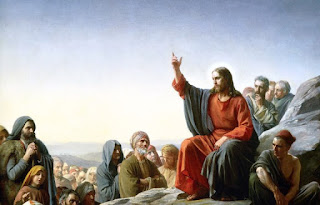
In ancient Jewish tradition, when a rabbi “sits down” after reading the Scriptures, it means he is about to give a homily (note 3). Thus, in the Sermon on the Mount, Jesus “went up the mountain, and after he had sat down, his disciples came to him [and] he began to teach them” (Mt 5:1-2).  It’s not hard to picture how electrifying the atmosphere is when Jesus sits down in the synagogue. Anticipation is keeping everyone wait. With a little Hollywood hyperbole, we can almost see them huffing and panting under the weight of suspense. The silence is deafening; one can hear a pin drop. But deep in the hearts of those watching closely Jesus’ every move, speculations and murmurs are rising like a tidal wave: Isn’t this the carpenter, the son of Joseph and Mary? Don’t we know his brothers and sisters very well (cf. Lk 6:22, Mk 6:3)? What is he going to say? 

What he says next, according to Luke, is a very brief statement: “Today this scripture passage is fulfilled in your hearing” (Lk 6:21).  Need he say any more? Here he is, finally, the Messiah promised by Isaiah’s oracle! He has been anointed to bring glad tidings to those living in poverty, which is everyone spiritually speaking; and to perform healing and miracles, which in a very real sense is another way to see Messiahship. As if to prove his words, he leaves his hometown and performs many miracles soon after the synagogue incident (Lk 4:31ff, 5:12-26).

We are the remnant of Jews listening to Ezra’s proclamation of the word of God. This world is our Babylon, our exile. The same word of God is proclaimed to us at every Mass. Do we have the reverence to listen attentively? Are we moved by the Spirit to say in one accord “Amen, amen!” in response to the proclamation? Can we feel the awesome power of the Word that is enough to crush our pride and literally wrestle our bodies down to prostrate to the ground? Do we see Ezra in our Mass celebrant who speaks from a higher ground and makes us mourn and weep? 


Notes:

1. See Foundations in Faith, Year C, p.112.

2. New Jerome Biblical Commentary 43:4.

3. Dr. John Bergma, Everlasting Jubilee, Franciscan University of Steubenville Summer Conference, 2018.


Monday, August 2, 2021

God Speaks Only One Word in the Whole Bible

And when the long-anticipated Christ event finally arrives, it often catches us completely by surprise: it comes with a theological significance and finality no scriptural readers could have expected.

 “Through all the words of Sacred Scripture, God speaks only one single Word”, and that Word is Jesus (CCC 102). The Church Fathers also taught that “one and the same Word of God extends throughout Scripture, that it is one and the same Utterance that resounds in the mouths of all the sacred writers” (St. Augustine, En. In Ps 103, 4, 1:PL, 1378). Personally, I like Pope Benedict XVI’s eloquent expression of this concept. He considers the Sacred Scripture, which is inspired by the Holy Spirit and written by many different sacred writers, “a symphony of the word, a single word expressed in multiple ways: a polyphonic hymn” (Verbum Domini 7). Jesus himself says just as much in his encounter with the two disciples on their way to Emmaus. He interprets to them what “all the scriptures” say about him, “beginning with Moses and all the prophets” (Lk 24:27). 

The Church has always read the Scripture on the understanding that the whole book is about Christ and points us to him. If something in the Scripture, especially in the Old Testament books, reminds us of Christ or bears resemblance to something he does or teaches in the Gospel, don’t see it as just an isolated “coincidence”. The resemblance or connection is often the Divine Author’s extraordinary literary expression, an integral part of His awe-inspiring narrative, meant to enlighten our mind, edify our faith, and draw us deeper into God’s unfathomable love and mystery. More importantly, their relationship is often sequential, one leading to the other, anticipating and heralding the final and definitive act in Christ. When the long-anticipated Christ event finally arrives, it often catches us completely by surprise: while the resemblance to the harbinger OT event is there, it comes with a theological significance and finality no scriptural readers could have expected. 

A good case in point is this Sunday’s readings. Both Prophet Elisha and Jesus are the architect of an incredible miracle. Elisha orders his servant to use “twenty barely loaves made from the first fruits, and fresh grain in the ear” to feed a hundred men (2 Kgs 4:42). When the servant objects because Elisha’s order seems so impossible, Elisha doubles down and promises that “They shall eat and there shall be some left over” (v. 43). The miracle happens just as Elisha has promised. In the gospel reading, Jesus orders his disciples to feed 5,000 men, which Philip considers as a mission impossible. “Two hundred days' wages worth of food would not be enough for each of them to have a little”, he protests (Jn 6:7). But the mission, seemingly impossible for Philip, is miraculously completed by Jesus using “five barley loaves and two fish”. When all said and done, everyone is full and leftover fragments collected are enough to fill twelve wicker baskets (Jn 6:9-13).

While both miracles are impressive and look similar, Jesus’ story is one that emerges from a Passover background. Central to the Feast of Passover, as we know well, is food consumption – the eating of the Passover lamb and unleavened bread (Ex 12:1-20). In ancient Jewish tradition, sharing meal is more than just a basic biological need driven by human appetite; it symbolizes unity and communion among the partakers of the meal. More importantly, its liturgical expression in relations with God communicates a divine will to strike a relationship of intimacy with the human party, as was the case in the ratification of the Mt. Sinai covenant, when Moses, Aaron, Nadab, Abihu together with the seventy elders of Israel went up the holy mountain where they “beheld God, and they ate and drank” (Ex 24:11; Theological-Historical Commission, The Eucharist, Gift of Divine Life, p.103). With this ancient Jewish tradition in mind, we recognize in Jesus’ miracle an added layer of mystique and significance: It points us to the unity, communion, and intimacy of the Eucharist.

Following the principle that one and the same Word extends through the Scripture, we can safely conclude from these two readings that Elisha’s multiplication of the loaves is a prelude or prefiguration, if you will, of Jesus’ multiplication of the loaves in John 6, pointing us to something bigger, more significant and definitive that Christ will bring. What’s that something? Note that Jesus’ multiplication of the loaves is strategically placed immediately before his extensive discourse on the “bread of life” in 6:35-59, which is by all accounts a discourse on the Eucharist (Ignatius Catholic Study Bible New Testament on John 6:1-14). Therefore, the two episodes can be seen as John’s one-two punch that introduces us to “the source and summit of the Christian life” – the Eucharist (CCC 1324).

In summary, it’s fair to say that Jesus’ multiplication of the loaves is prefigured by Elisha; its meaning and significance revealed and magnified by his discourse on the bread of life; its institution as a Sacrament liturgized in the Last Supper; its celebration faithfully carried out by the Church, his spouse. All of this has been mysteriously scripted by the sacred writers over the years in the course of the human history, under the inspiration of the Divine Author; and is finally “finished” by Jesus on the Cross, where the Body of Christ, the Heavenly Bread lovingly placed on a wooden holder for our consumption, is hung for all to behold and adore (Jn 19:30). Thus, the whole human history that has gone so wrong because of “the fruit of the tree” in the beginning, is finally set aright by the divine fruit of the tree – Christ on the Cross (Genesis 3:3).


Saturday, June 26, 2021

Summons

God’s summons to each one of us is ringing true in our hearts, daring us to respond, each in our own way.

Amaziah’s contempt is unmistakable when he calls Prophet Amos a mere “visionary” and orders him to leave Bethel to “earn your bread by prophesying” in Judah (Am 7:12-13). Bethel is where Amaziah serves his priesthood, which, sadly, he probably sees as a means for earning his bread. It is embarrassing to recall, but Amaziah’s words reminded me of how I had once offended my spiritual advisor many years ago. Yes, believe it or not, I said something similar although I meant no contempt! 

I was a second-year foreign student then at the University of Windsor, still learning the ropes when it came to the English language. A typically rebellious, liberal-minded, and anti-establishment unbeliever from the free-swinging, individualistic, rock ‘n roll days of the early seventies, I nonetheless had begun to acquire some interest in knowing the Gospel due to the influence of my peers at the Chinese Catholic Community in Windsor. Conveniently located in the south end of the campus, right beside the Ambassador Bridge to Detroit, was the Assumption Chapel, the center of the campus ministry of the Assumption University. That’s where I met my spiritual advisor, the pastor in charge of the Chapel and its campus ministry. He took very good care of all foreign students and was very kind to me. 

Our first private counselling session was for discovery: just getting to know each other. I told him my heart wasn’t quite at peace; it was full of youthful worries about my study and future career. He in turn told me his own background and how he became a priest. “How nice!” I blurted out, “Your career is all set. You don’t have my worries.” I could tell he was a little taken aback by my impromptu remarks, but overall, the meeting still went well.

Following the meeting, I rehashed and dissected the whole conversation every which way, sensing that something must have gone amiss. I even consulted a Catholic friend. Eventually I realized my terrible mistake of calling priesthood a “career”. It was partly a language issue - a misuse of word - and partly a poor understanding of the nuances of the Catholic priesthood. Of course, priesthood is really a vocation; a noble, selfless and courageous commitment in response to God’s calling; but never a “career”, nor just a way to “earn your bread”, as Amaziah says so contemptuously of Amos’ prophetic ministry in the first reading

I promptly called up my spiritual advisor and apologized to him profusely. Ever so kind and gracious, he said he knew I meant no harm. If my encounter with him got off to a rocky start, our relationship proved to be a close and lasting one. In Easter 1977, he baptized me and admitted me into the Catholic Church. Looking back, that moment in the Assumption Chapel when he poured water from the baptismal font on my head and then anointed me with oil and the power of the Holy Spirit was a thousand times more significant than my convocation two years later, which ironically had been my original and only reason for leaving Hong Kong to study in Windsor. A few years later, my spiritual advisor gave up the comfort of living in North America and went to Colombia to serve the poor and underprivileged. And there he remains until now.

When one reads St. Paul’s summary of “the riches of [God’s] grace that he lavished upon us” in the 2nd reading, it’s easy to understand why holy people like my spiritual director would choose to surrender their personal wants and direct their every thought, word and action to the service of God’s Kingdom through priesthood. “[H]e chose us in him, before the foundation of the world, to be holy and without blemish before him”, “he destined us for adoption to himself through Jesus Christ”, “in [Christ] we have redemption by his blood” – just to name a few (Eph 1:4, 5, 7). Who in their right mind – I say this literally, for the human mind is not right until it’s fully aligned to see God and worship Him – would hesitate to proclaim such good news to the best of their abilities? Those whose personal and circumstantial situations allow may even choose to do so unreservedly and radically through priesthood.

“Will you come and follow me if I but call your name? Will you let my love be shown? Will you let my name be known…” God’s summons to each one of us is ringing true in our hearts, daring us to respond, each in our own way. For a precious few, like the Twelve summoned by Jesus in this Sunday’s gospel, God’s summons demands a radical personal response, a complete surrender to Him for the love of others, that might entail taking “nothing for the journey but a walking stick – no food, no sack, no money in their belts” (Mk 6:8). In the case of my spiritual director, it meant leaving behind his family, friends, and a safe and comfortable life in North America and risking his own life in order to serve the poor and underprivileged in a country torn by years of social unrest, violence and internal strife.

Will you come and follow me if I but call your name? God’s summons rises in crescendo and dissolves into a whisper in the midst of the ebbs and flows of our daily life. Nagging and persistent, it’s a powerful voice that can be ignored but never forgotten. In Windsor, His summons came in a totally unexpected way. So many years later, it still does – in different forms and with even more urgency.


Saturday, December 26, 2020

At the Nativity Every Jaw Should Drop


When the Magi come to pay homage to the powerless infant in the manger, the time has come for Jerusalem to take the center stage, and for Daughter Zion to become the Bride of Christ.

Epiphany means “revelation”. The Solemnity of the Epiphany is historically associated with three “revelations” of Christ: to the Magi, the foreigners coming to Jesus, in a manifestation of the universality of his salvation; at his baptism in the Jordan, where the Trinitarian mystery is revealed; and at Cana in Galilee, where the overflowing joy of his nuptial union with the Church  is highlighted through the first of his signs (note 1). All three revelations remind us of the immensity of God’s saving love in Jesus as the Christmas mystery continues to unfold. 

What makes the Bible such a fascinating book to read is its uncanny ability to continue to surprise us at every turn of its narrative of the long history of salvation. When the fullest of time has come for God to reveal Himself to the world in the most definitive way, He chooses not to show up authoritatively – the way He appeared to Abraham, as three men standing at the entrance of his tent (Gen 18:1-10); or present Himself mysteriously - to Moses “in fire flaming out of a bush” (Ex 3:2-3); or exhibit His omnipotence terrifyingly - to Israel in “peals of thunder and lightning…and a very loud trumpet blast” on Mount Sinai (Ex 19:16). In the most unexpected and self-deprecating manner, He chooses to manifest Himself in a powerless and defenseless infant, “born of a woman, born under the law”, “laid in a manger because there was no room for them in the inn” (Gal 4:4, Lk 2:7).

I don’t know about you. For me, the Nativity is not only a timeless and beautiful story, but also the most shocking twist and turn in all of human history. One that the most nerve-wrecking suspense from a Hitchcock movie cannot even come close in comparison. St Paul says every knee should bend at the name of Jesus (Phil 2:10). I say every human jaw should drop to the floor in reflecting on the Nativity!

The surprises are indeed many. Chief among them is the profound mystery of Christ’s incarnation. Who would have thought that of all the ways that God could have used to come to us, He would choose to allow Himself to be restricted by His own creations – space, time, and the human nature? Who would have imagined that the almighty God would put Himself in harm’s way by plunging deep into the undercurrents of human history?  Who would have predicted – other than God Himself through His prophets – that He would come into this world through a virgin birth, and make Himself known to the world as a powerless infant in the little town of Bethlehem (cf. Is 7:14, Micah 5:1)? 

“And the Word became flesh and made his dwelling among us”, John proclaims the mystery joyfully in the prologue to his Gospel. “The Son of God became the Son of Man so that the sons of men could become the sons of God.” Like everyone else, St. Athanasius’ struggled mightily to understand such a profound mystery, but this definition he coined goes down in history as one that inspires countless theologians, clergy, and laity alike. Christ came not only to redeem us, but also to elevate our human nature to lofty heights unimaginable by any human mind. In so doing, he enables us to partake of God’s divinity, making us the children of God (2 Peter 4:4)! “See what love the Father has bestowed on us that we may be called the children of God. Yet so we are” (1 Jn 3:1)! Dumfounded and in disbelief, John can find no better words to express his amazement.

This has been a powerful reflection on the Epiphany of the Lord. But the jaw-dropping surprise doesn’t stop there. The theme of all three Mass readings is the universality of God’s saving grace. A universality that manifests itself in Jerusalem’s distant future, when “nations shall walk by your light”; when “your sons [shall] come from afar”; when “the wealth of nations shall be brought to you” (Is. 60:3-5). 

To St. Paul and the Jews, whose understanding of salvation has been restricted by God’s progressing pedagogy in the Old Testament to mean “salvation for Israel only”, the revelation of the mystery of universal salvation is a very big deal; or, shall we say, another jaw-dropping surprise. It’s a secret that “was not made known to human beings in other generations as it has now been revealed to his holy apostles and prophets by the Spirit, that the Gentiles are coheirs, members of the same body, and copartners in the promise in Christ Jesus through the gospel”. (Eph 3:5-6). When the Magi come to pay homage to the powerless infant in the manger, the time has finally come for the secret to turn into a reality, for Jerusalem to take the center stage in world history, and for Daughter Zion to become the Bride of Christ – the Catholic Church.

Note 1: See Foundations in Faith - Catechist Manual Catechumenate Year B, p. 32.


Saturday, November 28, 2020

The Holy Spirit’s Knock-Out Punch!


For those of you who are studying the Scripture seriously, I hope the Holy Spirit would also punch your lights out the way He did it to me!

Hidden in the corners of my mind are traces of memories left behind by a long spiritual journey that eventually led me to the totality of embracing the Cross of Christ. Like distinctive visions from an old-time movie, they would play out before my eyes in my prayers and meditations – a little scratched and blurry here and there, but the experiences are as vivid as yesterday. The carolers who sang joyfully as they walked past my parents’ eatery on Christmas day when I was a small child; my grade 10 classmate who bravely spoke up against our teacher’s disparagement of her Christian faith, and then broke down and cried; strumming my guitar casually as I sang Amazing Grace for the first time together with several camping friends under a starry sky – experiences such as these and many others that had brought me closer to Christ continue to support and re-energize me as I inch forward in a faith expedition that never ends.

As unforgettable and powerful as these experiences were, none of them could really deliver the “knock-out punch” that was needed to humble my puffed-up ego and enable me to truly surrender to Christ. But when it finally came (thank God it did!) it was in the least expected manner - in the form of a prolonged period of scriptural enlightenment. Through magisterial teachings and theological studies, the Holy Spirit was able to demonstrate beyond a shadow of a doubt that all of the Scripture was about Christ and formed a coherent whole only when it was read through the lens of Christ. That was no ordinary proposition. It’s tantamount to claiming that Jesus is everywhere in the Scripture, from Genesis to Revelation, from the Old Testament to the New Testament! The notion totally knocked me off my feet because I had always thought that Jesus, being a 1st C historical figure, was nowhere to be found in the Old Testament. 

This Sunday’s first reading from Isaiah 61 is a case in point. It provides a good illustration of the power of the pneumatic punch that eventually knocked me right out. 

“The spirit of the Lord GOD is upon me, because the LORD has anointed me” (Is 61:1) – Written more than 500 years before Jesus’ birth, this prophetic passage is already giving us many fine details about him (note 1). He is the Messiah – the Anointed One. He is to be anointed with the spirit of God and sent forth by the Father. 

What’s the purpose of the sending forth? “Bring glad tidings to the poor”, “heal the brokenhearted”, set free the captives and prisoners, announce God’s favor and vindication (cf. 61:1b-2a). In other words, Jesus is sent forth for all of us. In many ways, especially spiritually, every one of us is in extreme poverty. Like the “unclean” lepers in the Gospels, we are in dire need of healing and cleansing. Like Israel’s enslavement in Egypt, we are prisoners longing to be liberated. Beginning from Adam, the whole humanity has been fatally injured and unjustly persecuted by the power of Satan (cf. Lk 10:25-37; Pope Benedict XVI, Jesus of Nazareth I, pp. 199-200). But Jesus, the new Adam, has done us a huge favor. By the power of the Cross and his resurrection, we – humanity under persecution by Satan - have been vindicated. His saving grace is accessible to all of us. Anyone who is willing to embrace Christ and live in truth and righteousness is already victorious!

The Divine Author skillfully uses various images to present our Savior to us: He is clothed “with a robe of salvation”, “wrapped…in a mantle of justice”, “a bridegroom adorned with a diadem”, “a bride bedecked with her jewels” (Is 61:10). Small wonder that marriage is the main theme running through the pages of the Scripture. Our Savior comes to us as the Lover; he lovingly embraces us, the Beloved – the Church. He is a bridegroom adorned with a diadem. Compared this image to the fake bridegroom in Revelation who had “seven heads and ten horns, and on its heads were seven diadems” (Rev 12:3). More is not necessarily better! If the last image of “a bride bedecked with her jewels” is a little baffling to some readers, just keep in mind that it’s referring to the Church – Jesus’ “bride”. As the Body of Christ, the Church and Jesus are one.

Don’t know about you, but when I first understood – truly understood – the profound meanings of Old Testament passages such as what we’ve just read in this Sunday’s first reading, I was spiritually knocked unconscious, lying flat out and motionless on the canvas of the boxing ring! Like Jacob’s mysterious and bruising wrestle with God, I had battled Him for decades and He won with that knock-out punch (cf. Gen 32:25-30)! But that was not it. I had to take the same pneumatic punch over and over again in that prolonged process of scriptural enlightenment! “Love does no harm to the neighbor” (Rom 13:10). Surely, I wish to do my readers no harm. But for those of you who are studying the Scripture seriously, I hope the Holy Spirit would also punch your lights out the way He did it to me!


Note 1: It is generally believed that Isaiah 24-27, 56-66 were written by Trito-Isaiah in about 515 BC. Trito-Isaiah could be a disciple or several disciples of the author of Isaiah 40-55. The Prophet Isaiah himself wrote Isaiah 1-23, 28-39 sometime in the 8th C.


Saturday, October 24, 2020

Experiencing the Mystical Body of Christ

The doors of the Church that I knocked on 43 years ago are opening up to an abyss of mysteries far deeper than any human mind can fathom!

It’s hard to believe, but it’s been 43 years since I was baptized and received into the Catholic Church! In my 3rd year as a university student, I had completed enough courses required by my Accounting major to allow me to test my feet in the deep waters of Philosophy, which was never as clear-cut as the debits and credits of accounting journal entries. For whatever reason, the gods of Philosophy had always occupied the upper echelons of my youthful heart and captured my imagination of intellectual excellence. As soon as my accounting business was more or less dealt with, I couldn’t wait to take a few courses in Philosophy and dive right into the ancient world of the Greek philosophers and medieval thinkers. 

The connection shared by many of these early thinkers to the Judeo-Christian culture soon took me further back in history to one man who somehow seemed to me, a beginner learning to polish his tools of rational thinking, to be both the beginning and the end of all philosophical explorations - a Jewish sage named Jesus Christ. Looking back, it was no coincidence that I would join the Chinese Catholic Community on campus and, through them, the RCIA of the Assumption campus community. The Philosophy courses simply were insufficient to quench my thirst to learn more about this man. On this Feast day of All Saints, as I reflect on the Mass readings, I can see how the journey that first began when it took me to the doorsteps of the Catholic Church 43 years ago has given me much more than what I was bargaining for. 

The man who had aroused so much interest in me turned out to be more than just a man, he is both human and divine! He is the Word of God, “the Alpha and the Omega” that all wisdoms of this world come from and must return to, including the wisdom of every single philosopher that I’ve studied (Jn 1:1, Rev 21:6)! He came so that the world “might have life and have it more abundantly” (Jn 10:10). “See what love the Father has bestowed on us that we may be called the children of God. Yet so we are”, John marvels in the 2nd reading (1 Jn 3:1).

The doors of the Church that I knocked on 43 years ago, looking for answers to my quest for the true meaning of life, are opening up to an abyss of mysteries far deeper than any human mind can fathom! As I walk inside and look around with reverence and awe, I find myself standing on holy ground. I can relate to how Moses must have felt when he stood on Mt. Horeb in front of the burning bush (cf. Ex 3:1-5). When I look further, I realize I’m not alone. I see, as John does in this Sunday’s first reading, “a vision of a great multitude” – hundreds of thousands of people “from every nation, race, people, and tongue”, wearing white robes made “white in the Blood of the Lamb” (Rev 7:9, 14). These are the martyrs of the universal Church! They are chanting, “Glory and holiness and praise!” together with the angels, who are countless in number. 

Tiptoeing further along with my heart in my throat, I see many renowned figures that I’ve come to know through the writings of the Church Fathers. There’s St. Irenaeus of Lyons, waving at me and holding a book in his hand – his famous apologetic work, Against Heresies, in which he defends the Christian faith against heretical doctrines and traditions. Over there, on the other side of this heavenly place, stands St. Justin Martyr, wearing a bright and cheerful smile in spite of his horrific death. How can we thank him enough for testifying bravely to the Roman emperor of his days on how the Church worshiped (cf. CCC 1345)? And who is this medieval scholar who looks a little overweight? O, my Lord! Could this be St. Thomas Aquinas? He’s still working on Summa Theologica, the uncompleted work he left behind when he died in 1274. This is a little overwhelming! Where am I? Why am I in the midst of all these martyrs and saints?

Like all children of God, the Mystical Body of Christ is my true dwelling place day in and day out. We receive spiritual nourishments and graces lavishly and unceasingly from the Head of the Body – Christ himself (cf. Eph 5:23). We are drawn closer to Christ in the unity of this holy communion by the intercessory prayers of the saints (CCC 956-7). As a resident in Canada, we must observe the law of the country. Similarly, to be worthy of the privilege of the children of God, we must follow Jesus’ teaching. The Beatitudes in this Sunday’s gospel are in many ways “the new Torah brought by Jesus” that requires our close adherence (Jesus of Nazareth I, p.68). I will certainly do my best to follow his teaching and make sure I remain in his Mystical Body. Hopefully in my next Mystical Body experience, I’d be able to bump upon St. Augustine! Oh, I wouldn't mind seeing St. John Paul II too!

Monday, August 31, 2020

The Bible is in a Nutshell Just God’s Wedding Invitation

 If there is one theme that captures all messages that the Bible was written to convey, it’s marriage and family. 

St. John Paul II minces no words in pointing out the centrality of marriage and family in God’s plan of salvation: “The history of mankind, the history of salvation, passes by way of the family” (Letter to Families, 23).

The theme of marriage and family runs through the Bible like a thread, weaving its way intricately and skillfully from the first chapter to the last. It bookends the whole Bible, starting from the broken marriage and family of Adam and Eve in Genesis, ending with the perfect union of Christ and the Church in the wedding feast of the Lamb in Revelation. As if to punctuate its significance, Jesus' first miracle also happened in a wedding feast - the wedding at Cana.

Having lost its original luster in Adam and Eve due to the first parents’ original sin, the institution of marriage regains the preeminence of its immaculate state in the one-flesh unity of Christ and his Church – a unity manifested outwardly as a sign in the Sacrament of the Eucharist, and inwardly as an ontological reality and organic whole in the Body of Christ.

Both Christian marriage and the Eucharist are pointing us to something much bigger. The day will come when all of humanity - ancient, contemporary, and future; regardless of race, culture, and language - is invited to celebrate together with God and all the angels and saints above in an eternal, joyful, and heavenly wedding feast; which, to put simply, is what we call “heaven” or “the kingdom of God”; where, to elaborate further, justice and peace will reign and tears will be no more (Is 25:8, Rev 21:4). As a result of this divine plan, which must and will come to pass, the whole Bible should really be understood as an invitation from God for everyone to attend His heavenly wedding feast. It’s the heavenly Father’s call for His waylaid children to come home after a prolonged sojourn here on earth. “Blessed are those who have been called to the wedding feast of the Lamb” (Rev 19:9).

God’s invitation for us to attend this cosmic wedding feast has been expressed in many different forms scripturally. For example, in Proverbs, it’s expressed as “Wisdom” sending out her maidens to invite those who are “simple” and “lacking in understanding” to “Come, eat of my food, and drink of the wine I have mixed” (9:4-5). In Isaiah, it’s expressed playfully as God touting those who are thirsty and poor - people in need and deprived of real wealth - to drink and eat well from Him for free:

“All you who are thirsty, come to the water! You who have no money, come, receive grain and eat; come, without paying and without cost, drink wine and milk! Why spend your money for what is not bread; your wages for what fails to satisfy? Heed me, and you shall eat well, you shall delight in rich fare” (Is 55:1-2).

In this Sunday’s 1st reading, also from Isaiah, the same invitation is expressed powerfully as a cocktail of wedding goodies: 

Venue of the wedding feast – “On this mountain” (25:6). In other words, Mount Moriah where the Jerusalem temple was situated; it’s also where Abraham sacrificed his only son from Sarah, Isaac; and where God, the Father, sacrificed His only Son, Jesus. These biblical events are pointing us to the heavenly Temple of Jerusalem where the wedding feast of the Lamb is to take place (cf. Heb 8:1-5).

Who “will provide for all peoples” in this extraordinary cosmic event (25:6)? – God, just as Abraham had prophesized when he was asked a similar question by Isaac (cf. Gen 22:14).

What’s the menu? - “juicy, rich food and pure, choice wines”, as is already prefigured in the eucharistic feast the Church celebrates (25:6).

What will the host of the feast, the Groom, do in this wedding feast? – “he will destroy the veil that veils all peoples”, the way the groom unveils his bride during a wedding (25:7). This is also why when Jesus died, “the veil of the sanctuary was torn in two from top to bottom” (Mt 27:51). For what separates God and man must be completely destroyed by Jesus’ redemptive grace.

What more will the Groom do? – “he will destroy death forever...wipe away the tears from all faces; the reproach of his people he will remove from the whole earth” (25:8). Remember St. Paul’s defiance in confronting death? “Where, O death, is your victory? Where, O death, is your sting?” (1 Cor 15:55). Now we know why he was defiant.

What should we do on receiving the invitation to the wedding feast of the Lamb? – “let us rejoice and be glad that he has saved us!" (25:9) Amen! As St. Paul says, “Rejoice in the Lord always” (Phil 4:4).

Small wonder, given the riches of the theme of the wedding feast in the Isaiah reading, Jesus’ parable of the wedding feast is chosen by the Church as this Sunday’s gospel reading (cf. Mt 22:1-14). Jesus warns us to come prepared. We are told that those who are “not dressed in a wedding garment” will be cast “into the darkness outside, where there will be wailing and grinding of teeth” (Mt 22:13). Since the wedding garment “represents the righteous deeds of the holy ones”, the terrifying consequence for those experiencing wardrobe malfunction does make a lot of sense (Rev 19:8)!


Thursday, July 30, 2020

Finding Yourself Requires a Sincere Gift of Self


Jesus’ stern rebuke of Peter in this Sunday’s gospel - “Get behind me, Satan! You are an obstacle to me” (Mt 16:23) – is quite remarkable, considering that he has just given Peter the keys to the kingdom of heaven and the power to bind and loose only a few verses earlier (cf. Mt 16:19). 

What is the reason for Jesus’ strong words against Peter whose comment many will consider perfectly innocent and harmless? After all, his beloved teacher and leader has just revealed that he’s heading to Jerusalem to get killed! 

Here’s the problem. Peter’s reaction to Jesus’ shocking revelation, while well-intended, reflects a fundamental flaw in human thinking that doesn’t jive well with the Father’s divine will and Jesus’ way of confronting tribulations. Aversion to suffering is in the human instinct. Peter, like everyone of us, sees it as an undesirable thing that must be avoided at all costs. It is unpleasant, painful, and, in Jesus’ case, life-threatening. It even goes straight against our human pride, inflicting on us a sense of being overpowered and a feeling that we are losing control. Suffering, affliction, humiliation, death, and a whole host of other traumatic experiences are probably some of the things that race through Peter’s head to cause him to blurt out his unsolicited and unwelcomed advice to Jesus. 

People also see suffering as an affront to a person’s or institution’s power and authority. Why should Jesus allow himself to be overpowered by the Sanhedrin and the Roman authority if he is truly divine and almighty? Similarly, how can the Church suffer from scandal after scandal if it truly has God’s special protection against evils (cf. Mt 16:18)? 

That’s how Peter and many people in general see suffering. But God has a very different perspective. “For my thoughts are not your thoughts, nor are your ways my ways, says the LORD. As high as the heavens are above the earth, so high are my ways above your ways and my thoughts above your thoughts” (Isaiah 55:8-9). 

Like a good teacher, Jesus rebukes Peter, his student, and then explains his rebuttal with a clarity that leaves no room for bewilderment: “Whoever wishes to come after me must deny himself, take up his cross, and follow me. For whoever wishes to save his life will lose it, but whoever loses his life for my sake will find it” (Mt 16:24-25). Deny yourself; take up your cross and follow me; and your reward will be me – the way, the truth, and the life (John 14:6). Lose your life because of me, and you will save it.

The paradox presented by Jesus above is further explained by the Church this way: “Man cannot fully find himself except through a sincere gift of self” (Pastoral Constitution on the Church in the Modern World, n. 24). The more willing we are in giving ourselves away, the more successful we will be in affirming or establishing our true selves. For a person who gives is a person who loves. And the more we love, the better we resemble God, the perfect and infinite Lover (1 John 4:7-8). 

In the second reading, St. Paul’s appeal for us “to offer your bodies as a living sacrifice, holy and pleasing to God” is seen by Pope Benedict XVI as “the existential aspect of the new concept of worship and sacrifice” (Rom 12:1; cf. Jesus of Nazareth II, p.236). St. Paul shows us how to give ourselves away, and what it means to take up our crosses and follow Jesus. We should offer our bodies –everything we have – “as a living sacrifice, holy and pleasing to God”. In doing so – in excising our priestly duty in Christ to give away everything we have as a sacrifice to God, including our lives if necessary – we will end up gaining everything. For we will “have life and have it more abundantly” (John 10:10)! 

A few decades after the above-mentioned gospel episode, Peter, who had once coached Jesus to avoid suffering, would find himself willingly embrace martyrdom in Rome during the reign of Emperor Nero. His death brought fulfillment to Jesus’ prediction about him in the gospel of John: “When you grow old, you will stretch out your hands, and someone else will dress you and lead you where you do not want to go" (John 21:18). Peter would literally “take up his cross” and follow Jesus, offering his body – upside down on the cross according to Christian tradition, because he felt unworthy of sharing the same posture as his Savior - “as a living sacrifice, holy and pleasing to God”. In giving up his life, Peter found true life – everlasting and abundant. Through a sincere gift of self, he found his true self – vibrant, saintly and fully grown in Christ, “without spot or wrinkle or any such thing” (Eph 5:27).

Wednesday, April 22, 2020

From Shadows and Images into the Truth

Ever a gifted orator, St. Augustine was able to deliver a whole lecture on biblical theology in a few words: “The New Testament is hidden in the Old, and the Old Testament is manifested in the New”.


Just got off a video-conferencing meeting with a family Bible sharing group. Although everyone felt a little unnatural, the virtual gathering was nonetheless a welcomed opportunity to meet and share at an unprecedented time of national lockdown. If there was one common thread connecting all the families in isolation, it was a feeling of anxiety and fear. One family expressed concern that sooner or later the nursing home where their mother resided just might experience an outbreak. Another wondered if daily life would ever be the same when the crisis finally ended, whenever that might be. All of us were hoping our children would not lose their jobs – it’s like waiting for the other shoe to drop!

“Do not let your hearts be troubled. You have faith in God; have faith also in me “(John 14:1). These comforting words from this Sunday’s gospel cannot have come at a more opportune time! “Do not let your hearts be troubled”, “Do not be afraid”, “Peace be with you” – tender words such as these are constantly on Jesus’ lips (Mt. 14:27, Jn 14:1, 20:19). They sound great, but why should we believe him? In his own words, this is why: “If I do not perform my Father's works, do not believe me; but if I perform them, even if you do not believe me, believe the works...” (John 10:37-38). In other words, our faith in Jesus should rest in the works he performs. The works he performs are what the Father has foretold and commanded from time immemorial. He has brought them all to completion. So, believe!

The “Father’s works” that Jesus has brought to completion include everything foretold about him in the Old Testament – his divinity; his relationship with the Father; his incarnation, death, resurrection, and ascension. No human mind can claim to comprehend how God could have known, foretold, and brought to fulfilment everything about Himself through activities and events freely chosen and acted out by erratic humans over time in the volatility of world history. It’s a powerful mystery unfolding before our very eyes in the Old Testament and New Testament books, demanding our deepest reverence and unreserved submission of faith. Ever a gifted orator, St. Augustine was able to capture this awe-inspiring concept about the Scriptures in just a few words: “The New Testament is hidden in the Old, and the Old Testament is manifested in the New”. The Catechism simply calls it “typology” (CCC 128-130). Let’s use this Sunday’s readings to illustrate this important concept, which is absolutely critical for any serious Bible reader to master. We’ll focus on reading 2 – 1 Peter 2:4-9.

“Stone” is one of the most important images used in the OT scriptures to prefigure the Messiah. The book of Daniel, for example, uses “a stone which was hewn from a mountain without a hand being put to it” to prefigure the coming of the Messiah, whose Kingdom will replace all earthly kingdoms (Daniel 2:34). Here in the 2nd reading, Peter identifies Jesus with this OT image and sees him as the “cornerstone” upon which God’s house will be built (1 Pt 2:6, Ps 118:22, Is 28:16). He is also “the stone that the builders rejected” as Israel, the people chosen by God to build His house, was first unfaithful to God and later also rejected Jesus, His Son.

As THE foundation stone, Jesus appoints Peter as his representative on earth: “And so I say to you, you are Peter, and upon this rock I will build my church” (Mt 16:18). Peter, or “Petros” in Greek or “kepha” in Aramaic, the language spoken by Jesus, is a masculine noun for a sizeable “rock” or “stone” (cf. Ignatius Catholic Study Bible, p. 37). What Peter, the rock or stone, is telling us is that we are also living stones by virtue of our baptismal grace. Therefore, “let yourselves be built into a spiritual house to be a holy priesthood to offer spiritual sacrifices acceptable to God through Jesus Christ” (1 Pt 2:5). In other words, all Christians are mandated to be living stones like Peter and, by extension, Jesus. Together as living stones and God’s holy people, we are the Church, the house of God, the new Israel (LG 9). Affirming the same teaching, St. Paul asks, “Do you not know that you are the temple of God, and that the Spirit of God dwells in you?” (1 Cor 3:16). As the Church, we are holy because the Holy Spirit dwells in us.

By now our readers should be able to see the profound insight of St. Augustine’s dictum. The New Testament teaching that Christ is the Living Stone and we his Church, is already hidden in the Old Testament, even if it is not in a readily recognizable form (Dan 2, Ps 118, Is 28, etc.). The Old Testament images and prophecies that point us to Christ and his Church, while not immediately comprehensible in the context of the OT, are now made crystal clear in the truths and teachings of the New Testament (1 Pt 2, Mt 16, 1 Cor 3, etc.). St. John Cardinal Newman, sometimes known as an “invisible” Father of Vatican II due to his influence, used these last few words inscribed on his tombstone to teach us what reading the Bible from the OT to the NT is all about: “From Shadows and Images into the Truth”. His words are no less brilliant than the Augustinian dictum.

Wednesday, January 15, 2020

The Christmas Spirit of Humility and Lowliness


My heart is at peace in following Jesus’ descending path to lowliness, which is really the ascending path to see God face-to-face.

It’s difficult to recall precisely how Christmas first left its marks on my young cognitive faculties. The earliest experience I can think of was the blurry image of my primary school teacher dressed up as Santa, holding a bagful of beautifully wrapped presents, blurting out “Ho-Ho-Ho” as he walked on stage in front of a rowdy crowd of hundreds of wide-eyed schoolmates. If my memory serves me right, I think my immediate reaction was one of apprehension. Who on earth was this strange character dressed in some outrageous outfits? Why was my teacher, who was normally composed and dignified, acting like a fool?

That was pretty much my childhood Christmas experience in a nutshell: presents, Christmas cards, funs, parties. Other than a small group of people from a Christian denomination nearby, who would come to my parents’ shop on Christmas eve - all dressed up, candles in hands, caroling cheerfully as they processed - Christmas to me was just a special time for social activities. But over the years, as my Christian faith deepened and my secular heart enlightened by the Holy Spirit, my perception gradually underwent a complete transformation. No longer do I see Christmas as a mere occasion for celebrations and festivities; I am convinced its deeper meaning lies in its religious solemnity. Nor do I enjoy much the delusional feeling of affluence that the Christmas presents bring; I believe the real affluence of Christmas can only be found in its spirit of humility and poverty, starting from the lowliness and destitution of the manger where Jesus, the “King of kings and Lord of lords”, was born (Rev 19:16).

Here we are, barely a month after the Christmastide, on this 5th Sunday of Ordinary Time, the Christmas spirit of humility, poverty and lowliness is still very much alive and visible in the Mass readings: Take care of the hungry, the homeless, and the naked, Isaiah exhorts in the 1st reading (cf. Is 58:7-8). In the 2nd reading, we find Paul preaching to his disciples not “with sublimity of words or of wisdom” but “in weakness and fear and much trembling” (1 Cor 2:1,3).

According to Pope Benedict XVI, the Beatitudes are the best definition of Christian discipleship. Who are Jesus’ true disciples? The lives of the true disciples of Christ must exhibit the ascetic attributes of the Beatitudes, says the Pope. “They are poor, hungry, weeping men; they are hated and persecuted” (Jesus of Nazareth I, p.73). Not surprisingly, the life of Jesus is in itself the fullest manifestation of the Beatitudes (ibid, p.74). It is a life of simplicity, poverty, sorrow, and persecution that culminates or, the world would say, “bottoms out” in his death on the Cross.

In the gospel, Jesus asks his disciples to be “the salt of the earth” and “the light of the world”; their “light must shine before others” (cf. Mt. 5:13-16). As Jesus will not ask from us anything that he himself doesn’t do, he himself is actually the light “set on a lampstand”, the light that “must shine before others” (cf. Mt. 5:15-16). As Jesus’ followers, we follow his example to “shine before others” when our lives manifest the same radicalism of the Beatitudes, the same poverty and lowliness that define the life of our Lord.

As I reflect on the years gone by, from childhood to old age, from primary school to senior community, from my first Christmas experience in Hong Kong to the most recent one here in Toronto; my heart is overwhelmed by a profound feeling of thankfulness: thankful because my understanding of the meaning of Christmas has really come a long way; thankful because with God’s blessing and unfathomable patience, I have managed to leave behind the culture of possession and delusional affluence to embrace the culture of service and inner freedom; thankful, most of all, because my heart is at peace in following Jesus’ descending path to lowliness (his destitution, poverty, suffering, and death), which, as my mentor Pope Benedict XVI has assured me, is really the ascending path to see God face-to-face (cf. Jesus of Nazareth I, p.95). As Christians, our conviction is that the only way to shine is the way of the Cross.

I’d like to conclude this reflection with this scriptural passage: “Though he was in the form of God, [he] did not regard equality with God something to be grasped. Rather, he emptied himself, taking the form of a slave, coming in human likeness…he humbled himself, becoming obedient to death, even death on a cross. Because of this, God greatly exalted him” (Phil 2:6-9).

Thursday, January 2, 2020

依撒意亞預見的新耶路撒冷

「耶路撒冷啊!起來炫耀罷!因你的光明已經來到,上主的榮耀已經照耀在你身上。舉起你的眼向四方觀望罷![萬民]都聚集來到你這裡」(依 60:1, 4)。


那是以色列面對滅亡的危機,四面楚歌的時刻。在北面,北以色列王國已經瓦解;在南面,耶路撒冷又被亞述王散乃黑黎布入侵。先知依撒意亞充滿希望的訊息,既讚揚耶路撒冷的光輝,又幢景美好的將來;對以色列人來說,這本來是鼓勵的說話,其實更像一個莫大的諷刺。然而,在歷史的光照和藉著回顧的幫助,今天我們才知道他的預言其實準確得令人難以置信。

本主日的第一篇讀經,先知以像雷射般精準的目光來看未來,預見新耶路撒冷蒙受「上主的榮耀」(依 60:1)。耶路撒冷聖城已成過去,它在公元 70 年被羅馬人攻陷、摧毀;按猶太歷史學家 Josephus,有百多萬居民被屠殺或因饑荒而死亡。但教會—新耶路撒冷—卻出現於世界歷史舞台上,把聖城延續下去, 但不是取代了它(CCC 756)。同樣地,耶路撒冷聖殿已成過去,它也被夷為平地,如耶穌所預言,沒有一塊石頭留在另一塊石頭上 (參 路 21:6)。聖殿既被摧毀,梅瑟法律規定的祭獻及亞郎司祭職,也無可避免地突然中斷了。然而,透過聖祭禮儀、以基督為中心的聖事及從伯多祿傳下來的聖秩職份,教會—新的耶路撒冷聖殿—接過了聖殿欽崇和聖化的神聖職務,並延續至今。

我們絕對不應該因為看見教會有時候會出現的「瑕疵...皺紋,或其他類似的缺陷」而震驚至目瞪口呆(弗 5:27)。我們這樣說並不是意圖輕輕抹過每次教會犯錯時所帶來的後果的嚴重性,和這些事情如何危害著伯多祿這條船(參閱路8:22-23)。如果說人生是一個讓我們學習及努力達致完善的過程,歷史便是一個讓教會—新耶路撒冷—進步並輾轉地日趨圓滿的過程。常被稱為聖城的教會,在經歷著煉淨;基督會使教會「成為聖潔和沒有污點的」(CCC 756, 弗 5:27)。「我們就是活石,要在此世形成一個屬神的殿宇」,直至天地更新,新耶路撒冷便會「從天上由天主那裡降下,就如一位裝飾好迎接自己丈夫的新娘」(CCC 756, 默 21:2)。

依撒意亞所預見的新耶路撒冷也是屬於天下萬民的:「萬民要奔赴你的光明...他們都聚集來到你這裡」(依 60:3-4)。儘管依撒意亞的預言對當代猶太人來說是不可思議的 - 因為他們排斥外邦人,認為他們是「不潔」的 - 但是它卻在至公的教會中得以圓滿實現。「至公」一詞最早由安提約基雅的聖依納爵(公元 108 年卒)首先使用,是普世及或天下萬民的意思。在第二篇讀經中,聖保祿在論及公教會這重要的特性時說,它是「藉著啟示,使我得知 ⋯ 的奧秘」(弗 3:2)。在這普世或至公的天國的奧秘中,「外邦人藉著福音在基督耶穌內與猶太人同為承繼人,同為一身,同為恩許的分享人」(弗 3:6)。

如此說來,我們便明白為何本主日的讀經以《瑪竇福音》三位賢士來朝的記載來結束。在多年準備、預言及期待之後;在漫長的分娩及產痛之後;歷史終於給人誕下了救世主,他是「一個嬰兒,裹著襁褓,躺在馬槽裡」(路 2:12)。祂會讓萬有修和,重歸於好:「無論是地上的,是天上的,都與自己重歸於好,因著他十字架的血立定了和平」(哥 1:20)。時候將到而且現在就是,拆毁所有屏障吧!除去一切仇恨和萬民之間的敵意吧!看啊!他們來了:來自東方和代表著外邦人的三位賢士;他們向新生王致敬,帶來了「禮物:黃金、乳香和沒藥」,明認著祂的王權、天主性和苦難;就如依撒意亞所預視的一樣 (瑪 2:11, Ignatius Catholic Study Bible)。

Wednesday, December 11, 2019

The New and Glorious Jerusalem As Envisioned by Isaiah


The time has come for all barriers to come down, all hatreds to disappear, and all hostilities among the nations to vanish.

“Rise up in splendor, Jerusalem! Your light has come, the glory of the Lord shines upon you…Raise your eyes and look about; [the nations] all gather and come to you” (Is 60:1, 4).

At a time when Israel’s survival as a nation is threatened by the collapse of the kingdom of Israel in the north and the invasion of Jerusalem by Sennacherib, the king of Assyria, in the south, Isaiah’s message of hope that extolls the splendor of Jerusalem and its glorious future must have sounded more like a mockery than an encouragement to its people. But with the benefit of hindsight and the enlightenment of history, now we know his prophecy is in fact so accurate that it strains credulity.

With a laser-sharp futuristic vision, the prophet foresees in this Sunday’s first reading a New Jerusalem upon which “the glory of the Lord shines” (Is 60:1). Gone was the city of Jerusalem, sacked and destroyed by the Romans in 70 A.D; its residents, more than one million of them according to the Jewish historian Josephus, massacred or left to die from famine. Appearing on the world stage of history, not as a replacement but as a continuation, was the Church, the New Jerusalem (CCC 756). Gone also was the Jerusalem temple, razed to the ground, not one stone was left upon another as Jesus had predicted (cf. Lk 21:6). With the temple demolished, all but inevitable was the abrupt termination of the Mosaic sacrifices and Aaronic priesthood. The sacred duties of worship and sanctification of the temple have been taken over and continued until this day by the Church, the New Jerusalem Temple, through its divine liturgies, Christ-centered sacraments, and Petrine priesthood.

Never should we be taken aback by the “spot or wrinkle or any such thing” that we see in the Church every so often (Eph 5:27). We say this without minimizing the seriousness of the consequences that endanger Peter’s boat whenever the Church falls short (cf. Lk 8:22-23). If life to us is a process of learning and striving for excellence, history to the Church, the New Jerusalem, is a process for it to progress and spiral towards perfection. The Church, often referred to as the Holy City, is undergoing purification; it will be made “holy and without blemish” by Christ (CCC756, Eph 5:27). “As living stones we here on earth are built into it”, until the world is made anew and the New Jerusalem “[comes] down out of heaven from God, prepared as a bride adorned for her husband” (CCC756, Rev 21:2).

The New Jerusalem envisioned by Isaiah is also for all nations: “Nations shall walk by your light…they all gather and come to you” (Is 60:3-4). While unthinkable to the Jews at the time who shunned the Gentiles because they were considered “unclean”, the prophecy is perfectly fulfilled in the Catholic Church. “Catholic”, a word first used by St. Ignatius of Antioch (d. 108 AD), means universal or for all nations. St. Paul refers to this important attribute of the Church as “the mystery [that] was made known to me by revelation” in the second reading (Eph 3:2). In this mystery of the universality or catholicity of the kingdom of God: “the Gentiles are coheirs, members of the same body, and copartners in the promise in Christ Jesus through the gospel” (Eph 3:6).

Now we know why the Church concludes this Sunday’s readings with Matthew’s gospel account on the visit of the three wise men. After many years of preparation, prophecy, and anticipation; after a lengthy labor and many painful birth pangs; history has given birth, in this “infant wrapped in swaddling clothes and lying in a manger”, to the world’s savior (Lk 2:12). He will reconcile all things, “making peace by the blood of his cross, whether those on earth or those in heaven” (Col 1:20). The time has come for all barriers to come down, all hatreds to disappear, and all hostilities among the nations to vanish. So here they come: three wise men from the east, representing the Gentile nations; paying tribute to the new born King; bringing with them “gifts of gold, frankincense, and myrrh” in recognition of his Kingship, Divinity, and Passion; just as Isaiah has envisioned (Mt.2:11, Ignatius Catholic Study Bible).

Wednesday, October 9, 2019

“For the Son of Man has come to seek and to save” (Luke 19:10)

We like to think that we can have God in our own pockets. But we’ve got it all wrong. It’s God who finds us and reveals Himself to us; it’s Him who saves us.


“For the Son of Man has come to seek and to save what was lost” (Lk 19:10). With this stunning statement from Jesus, this Sunday’s Mass readings conclude with a big bang.

Jesus, the Son of Man, is divine; he is God. In making this statement, what he is saying effectively is that God has PERSONALLY come to seek us out and to save us! “What was lost”, understood in its individual sense, refers to you and me, who are “lost” because we are sinners. When understood corporately, the term means the whole creation, which “was made subject to futility…[and] is groaning in labor pains even until now” since the fall of our first parents (Rom 8:20, 22). What is so stunning about Jesus’ claim? Think about it: God, the Almighty, in whom “all things in heaven and on earth, the visible and the invisible” were created and before whom “every knee should bend”, somehow has chosen to humble Himself and descend into this lower sphere that is ours, which is both sinful and chaotic, in order to seek and save us (Col 1:16, Phil 2:10)! If this is not stunning, I don’t know what is.

The Judeo-Christian concept that sees salvation as a top-down, divine effort from above - not a bottom-up, human effort from below - is unique and highly intriguing. Just as intriguing is the consistency of the Scriptures in advancing this idea. “It was not you who chose me, but I who chose you”, insists Jesus (John 15:16). Long before him, we have Ezekiel’s prophetic declaration: “For thus says the Lord GOD: I myself will look after and tend my sheep” (Eze 34:11, italic mine). Before Ezekiel, Isaiah’s message is just as enlightening: “Say to those whose hearts are frightened: Be strong, fear not! Here is your God, he comes with vindication; With divine recompense he comes to save you” (Is 35:4, italic mine).

“Jesus’ death”, explains Pope Benedict XVI, “[is] the fulfillment of a love in which God himself comes down to us, so as to draw us back up to himself” (Jesus of Nazareth II, p. 253). In other words, salvation is a divine initiative in which God descends to seek and save us out of love, not a human endeavor in which we ascend to attain divine greatness, as so many religions outside of the Judeo-Christian tradition generally believe. It is a cosmic and monumental undertaking carefully thought out and miraculously accomplished by God and God alone. It’s a merciful act because its benevolence we do not deserve. It’s called grace because what’s bestowed on us is from above, beyond human ability and comprehension.

Is this a totally one-sided equation – a purely God-driven undertaking that requires or allows no human input whatsoever? No. What is required – and what God has graciously allowed in order to make us a partner, no matter how small, of this monumental endeavor - is our free and humble response to God’s call for repentance. It’s exactly what Jesus asked of us when he proclaimed the coming of his kingdom: “Repent, for the kingdom of heaven is at hand” (Mt 4:17). He was inviting the world to get ready for this important partnership.

A case in point is this Sunday’s gospel. Zacchaeus, a chief tax collector in Jericho, repents upon seeing Jesus, and promises to give away half of his possessions to the poor and repay four times over anything he has extorted from anyone (Lk 19:1-2, 8). Zacchaeus repents in both words and deeds. He does so because he realizes he has sinned. And he is able to realize because he has humility in his heart, which causes him to repent. True repentance will not go unnoticed by Jesus. He sees in Zacchaeus, who is “short in stature”, a giant of a man because he, like Jesus, is willing to humble himself. He is ready for partnership; he can be saved.

It pains my heart to see that so many people still rely on their own effort to try to “find God”. They work hard to “elevate themselves spiritually to a higher level of perfection”. We like to think that we can have God in our own pockets. But we’ve got it all wrong. It’s God who finds us and reveals Himself to us; it’s Him who saves us even though His economy of salvation always has room for our input and partnership – our repentance. This reminder from Jesus is spot on: “It is not you who chose me, but I who chose you” (John 15:16).

Saturday, November 17, 2018

The Woman Who Makes Christmas Great

Jesus is our Lord and the reason why we celebrate Christmas. But in this Christmas, let’s also remember the woman who makes it great.


The day is edging to leave earlier, receding far below the horizons when mother earth is still unprepared for the looming darkness. The night…O, how she drags her feet shamelessly and overstays her welcome! With temperatures falling, light snow drifting, and the winds picking up speed, one doesn’t really need the busy downtown streets and the packed shopping malls to confirm that Christmas is here. Uncomfortable weather conditions aside, Christmas is always the time of the year when our hearts suddenly regain affections for the people around us; and our countenance, stern and robotic all year long, suddenly regains its human expressions. In this beautiful Christmas season, elodocuments would like to wish our readers peace, joy, and many wonderful blessings from the Lord! Now, let’s turn our thoughts to the Mass readings of the last Sunday of Advent - already filled with a festive, yuletide flavor as it is - to reflect on the woman who makes Christmas great for all of us.

"Blessed are you among women and blessed is the fruit of your womb” (Luke 1:42). Prompted by the Holy Spirit, Elizabeth cries out loud on seeing Mary in this Sunday’s gospel. How is Mary blessed? Mary is blessed in many ways. We will count two of them in this cursory reflection.

She is blessed because she’s the woman foretold by the prophets to give birth to Christ, our Savior. This Sunday’s first reading is a prophecy of great significance from Micah, a Judean prophet who lived about 700 years before Jesus. He announces the coming of two critical figures: a woman “who is to give birth” in Bethlehem to “the ruler in Israel Whose origin is from of old, from ancient times” (Mi 5:1-2). The ruler the woman gives birth to “shall stand firm and shepherd his flock by the strength of the LORD…and…his greatness shall reach to the ends of the earth; he shall be peace” (Mi 5:3-4). Who is this woman? Who is the child she gives birth to? Inspired by the Holy Spirit, St. Matthew applies Micah’s prophecy to Mary and her infant, Jesus (cf. Mt. 2:4-11).

Mary is also blessed because she is the woman prefigured by special women of faith and courage in the OT. Whether it’s the first woman of the Bible, Eve, from whom the whole human race descends; or women of barrenness - Sarah, Rebekah, Rachel, and Hannah - whose special pregnancies are the gifts of God; or women of lowliness like Rahab (a harlot who helped Joshua and Israel to conquer Jericho (cf. Jos 2:8ff)) and Ruth (a gentile woman married to Boaz, from whose line Jesus descends (cf. Mt 1:5)); or women of courage and liberation like Esther and Judith; or women of queenship like the queen mothers of the kings of Judah (particularly Bathsheba, the queen mother of Solomon (cf. 1 Kgs 2:19)); every one of these OT women is chosen by God to point us to Mary, the woman who mothers the whole human race spiritually, conceives miraculously in spite of “barrenness” (“I have no relations with a man” (Lk 1:34)), humbles herself as “the handmaid of the Lord”, assists Jesus in the salvation and liberation of mankind as his Co-Redemptrix, and is enthroned by her Son as the heavenly Queen Mother.

Mary is the woman of history. Together, Eve and Mary form the bookends of the Bible, one inaugurating the long history of salvation with human woes due to her disobedience, the other bringing it to a joyous conclusion because of her obedience. This is why Mary is called the New Eve and why she is succinctly identified by St. Irenaeus as the woman who unties the knots of Eve’s disobedience.

What’s in between the two bookends of the Bible, i.e. in between Eve in Genesis and Mary in Revelation (the woman clothed with the sun, with the moon under her feet)? Another woman, the bride in the book of the Song of Songs – a book purposely placed at the center of the Bible. The sweet romance between the bride and her groom, laid bare in the biblical centerfold, points us to the sweet romance between the Marian Church (the bride, the mother, the New Eve) and the Lord Jesus (the groom, the New Adam). It’s only appropriate that the Bible should conclude with the Marian Church – the woman, the bride – urging her journeying husband to return: “Amen! Come, Lord Jesus” (Rev 22:20).

Jesus is our Lord and the reason why we celebrate Christmas. But in this Christmas, let’s also remember the woman who makes it great.

Wednesday, October 24, 2018

The “Little Apocalypse”

Are we nearing the day of the sun darkening, the moon losing its light, and the stars falling from the sky?


The gospel reading of Sunday November 18, 2018 (33rd Sunday in Ordinary Time) comes from one of the most difficult sections of Mark that is commonly known as the Olivet Discourse or “Little Apocalypse” (Mark 13:1-37). It’s so named because the discourse between Jesus and his four apostles - Peter, James, John, and Andrew - took place while Jesus “was sitting on the Mount of Olives opposite the temple area”, and its literary style is dominated by apocalyptic and prophetic symbolism (Mark 13:3).

Hard to miss is the eschatological overtone of the gospel reading: “[I]n those days…the sun will be darkened, and the moon will not give its light, and the stars will be falling from the sky, and the powers in the heavens will be shaken”; “and then [the Son of Man] will send out the angels and gather his elect from the four winds, from the end of the earth” (Mark 13:24-25, 27). ). The nerve-racking, end-of-the world language that begins with visions of the celestial bodies in disarray, rises to a crescendo with the appearance of the “Son of Man” - the royal, Messianic figure in Daniel 7 whose enthronement in heaven caps off the Last Day – and ends in a thunderous blast when Jesus warns that “this generation will not pass away until all these things have taken place” (Mark 13:30).

If there’s any doubt about the theme of this Sunday’s readings in spite of the eschatological language of the gospel reading, the first reading, also from the Book of Daniel, is selected to drive home the prophetic warning that the day is coming when the whole human race – from now to ancient times, from the current generation to Adam and Eve - must witness the unthinkable occurrence of the resurrection and the Last Judgement. "Many of those who sleep in the dust of the earth shall awake; some shall live forever, others shall be an everlasting horror and disgrace”, Daniel predicts (Daniel 12:2).

A key difficulty of the Olivette Discourse is that what is apparently a depiction of the end of the world that includes cosmic and catastrophic atrocities is predicted to occur at a time that is plainly inaccurate if understood literally. According to Jesus, “this generation will not pass away until all these things have taken place” (Mk 13:30), which suggests that the fulfillment of these eschatological events would have already taken place within the lifetime of his contemporaries. If that’s the case, why are we still here two thousand years later, alive and kicking?

When it comes to biblical exegesis (interpreting the various passages of the Bible), it’s important to understand the difference between the literal sense and the spiritual sense (see CCC 115-119). Literally, “the sun darkened”, the moon losing light, “the stars falling from the sky” (cf. Mark 13:24-25) suggest physical, cosmic disturbances. Spiritually these visions of heavenly chaos can be understood as God’s judgment against the pagan ways of Jerusalem which in Jesus’ time had deteriorated to an unseen level in terms of faith and morality (see commentary of Ignatius Catholic Study Bible New Testament on this passage). The final punishment of Jerusalem, mentioned repeatedly by the OT prophets and Jesus himself, would be so sweeping and devastating that it could only be described in end-of-the-world language. In 70 AD, which is well within the lifetime of Jesus’ contemporaries, a large Roman army under the generalship of Vespasian, the future Roman Emperor Titus, besieged and conquered the city of Jerusalem, demolishing the 500-hundred-year-old Temple, plundering the whole city, and killing 1.1 million people, of which the majority were Jewish. The rest is history.

For real-life application, let us end this reflection with a few thought-provoking questions: Given the “pagan ways” of our world today and its new lows in morality and faith, can we see the city of Jerusalem of 70 AD as the prefiguration of the world we live in? As the residents of this “world city”, are we in danger of an imminent and devastating destruction that might sweep away not only a city but the whole world? Are we nearing the day of the sun darkening, the moon losing its light, and the stars falling from the sky?