
The heavens declare the glory of God; the sky proclaims its builder's craft (Psalm 19:2). elodocuments is an English/Chinese bi-lingual blog that shares based on the Catholic faith.高天陳述天主的光榮,穹蒼宣揚祂手的化工(詠19:2)。elodocuments 是個用中英語分享天主教信仰的網誌。
Saturday, May 17, 2025
American Cardinals Held News Conference in the Vatican after Election of the Pope
American Cardinals Held News Conference in the Vatican after Election of the Pope
Wow! I enjoyed watching every minute of this news conference. The Americans in general are good in expressing themselves, even more so are their clerics because an important part of their work is public speaking. And the cardinals in the news conference did not disappoint. So many thoughts crossed my head as I listened to them but one really stood out.
A few times in the conference comparison was made between the US election last year and this papal election. In spite of the reporters' suggestions again and again that the two were related and that the cardinals had Trump in mind in selecting Pope Leo XIV, the American cardinals, one after another, insisted that what they had in mind was to elect a leader whose focus was the Church's priorities: the Christian faith, Church unity, love for the poor and for those in need. The dialogue revealed once again the difference between the world and the Church. The world, represented by the reporters, finds it hard to understand the Church's priorities because for them they are not true priorities The cardinals were telling them the truth but they couldn't believe the election of Pope Leo XIV was not about Trump. A very insightful and enjoyable video to watch. 44 minutes went by like a breeze for me. Credit to Fox News for broadcasting the conference.


Getting to Know Pope Leo XIV Up Close and Personal Before He Became Pope
Evening of Reflection with Cardinal Prevost and Mass, August 7, 2024
This video is a wonderful opportunity to get to know Pope Leo XIV up close and personal. It was August 2024 - a few months before he became pope. He spoke English, his mother tongue, talking to his country people. He came across as a very humble and down to earth person. As Augustinian, he is probably very intellectual and a master in Catholicism. At the same time, he's also a missionary who cares deeply for the people he shepherds. He was already working in Rome at the time of the video. His good understanding of how things worked in Vatican also showed. I watched the whole interview and the homily. I enjoyed every moment of it.
One thing I came away with on watching the interview was his reply to the question: Some people and some in the Catholic media were critical of Pope Francis, fearful that he might do things to hurt the Church. Cardinal Prevost's reply was exactly what I'd expect: trust the Holy Spirit; he would not abandon the Church of Christ! He went on to say that the Church needed Pope Francis when he got elected in 2013, just as she needed Benedict in 2005 and JPII back in 1978. Do not be afraid! Jesus had promised to send the Holy Spirit to guide his Church into all truth, and Jesus will keep his promise!
Tuesday, December 19, 2023
Blessing of Same Sex Couples
https://www.cnn.com/2023/12/18/europe/pope-francis-same-sex-couples-blessing-intl/index.html
If you read the above CNN news report on Vatican's decision to bless same-sex couples today (or the same from any other major news outlet), you will get the wrong impression that the Catholic Church is moving away from its longstanding opposition to same-sex marriage (SSM) because it finally agrees to bless the same-sex couples.
The news report also accused the Church of changing "a 2021 ruling from the Vatican doctrine office which barred any blessings" of same-sex couples. The implication was that the Church's teaching is not to be taken seriously because it can change and has changed in this case.
Nothing is further from the truth.
If you read Vatican's Declaration directly (Fiducia Supplicans, Declaration on the Pastoral Meaning of Blessings, December 18, 2023), you will realize that the Church remains firm in its opposition to SSM; and that the 2021 ruling barring any blessings of SS couples remains valid.
If anything, the Declaration re-affirms again and again the Church's opposition to SSM, insisting that marriage is the "exclusive, stable, and indissoluble union between a man and a woman, naturally open to the generation of children". It emphasizes that "the Church's doctrine on this point remains firm" (n.4).
What the document does is to clarify that there are two kinds of blessing. A liturgical blessing "requires that what is blessed be conformed to God's will, as expressed in the teachings of the Church" (n.9). As an example, what the Sacrament of Matrimony confers is a liturgical blessing. As SSM does not conform to God's will and is morally wrong, it cannot be blessed. So, the above-mentioned 2021 ruling remains unchanged. In other words, the CNN report's accusation that the Church's teaching has changed is wrong.
The second kind of blessing is a general, pastoral blessing which allows the Church or an ordained minister to bless someone - anyone - who has the humility to realize that they need God's mercy and help "to move forward, to live better, and to respond to the Lord's will" (n.20). This kind of blessing is essentially open to everyone. There's no need for the Church or an ordained minister to scrutinize closely the moral status of the receiver of the blessing to ensure they "have prior moral perfection" (n.25). Blessing for same-sex couples and couples in irregular situations (divorced and remarried for example) falls into this category.
In this special season of Advent, let's pray for unity and harmony in the Church handed down to us from St. Peter and the Apostles. Let's pray in particular for the Holy Father, who is constantly in need of the Holy Spirit's guidance and protection.
Tuesday, August 1, 2023
How Accepting the Church as Petrine Transformed Me
The stunning realization transformed me miraculously, turning me from a “Church rebel” into a passionate “Church defender”.
I will place the key of the House of David on Eliakim's shoulder; when he opens, no one shall shut, when he shuts, no one shall open (Is 22:22).
I will give you the keys to the kingdom of heaven. Whatever you bind on earth shall be bound in heaven; and whatever you loose on earth shall be loosed in heaven (Mt 16:19).
I was dumbfounded when the above two verses from Isaiah and Matthew respectively were first paired up for comparison and the deeper meanings revealed by Dr. Scott Hahn in one of his earlier cassette-tape series on biblical studies. Born a rebel who customarily disliked any establishments and institutions, particularly the Catholic Church, I found Dr. Hahn’s comparison and insights fascinating and convincing.
Through Isaiah’s prophecy,
God promises to give “the key of the House of David” to Eliakim, which
signifies authority and power. He will represent the king and act as his
governor or prime minister, if you will, governing the kingdom of David. More
importantly, the authority given to Eliakim is complete and unreserved: “when
he opens, no one shall shut, when he shuts, no one shall open”.
What is really striking is that Isaiah’s prophetic words that made Eliakim the leader governing the kingdom of David on behalf of the king were adopted almost word by word by Jesus when he made Peter (originally named “Simon”) the first leader of his Church, which is already the seed and the beginning of the kingdom of God on earth (LG 5). In response to Simon Peter’s confession that he was “the Christ, the Son of the living God”, Jesus said, “I will give you [Peter] the keys to the kingdom of heaven. Whatever you bind on earth shall be bound in heaven; and whatever you loose on earth shall be loosed in heaven” (Mt 16:19).
By adopting Isaiah’s prophetic words intentionally, Jesus is making three very significant points:
1. Jesus makes Peter the Sovereign Pontiff of his Church
- Just as God made Eliakim the representative and governor of the kingdom of
David by giving him the key of the house of David, he is making Simon Peter the
vicar of his Church on earth by giving him the keys to the kingdom of heaven. As
the Church on earth is already the seed and the beginning of that kingdom,
Peter represents Jesus to govern his kingdom of heaven here on earth (LG 5).
This is what the Catholics mean when they say the Church of Christ is Petrine.
2. The Sovereign Pontiff’s authority over the Church is complete and unrestricted - Just as Eliakim’s governing authority was complete and
unrestricted – “when he opens, no one shall shut, when he shuts, no one shall
open” – the governing authority of Peter and his successors is also complete
and unrestricted. Thus: “Whatever you bind on earth shall be bound in heaven;
and whatever you loose on earth shall be loosed in heaven”.
3. The Church is built on Peter and his successors - And so I say to you, you are Peter, and upon this rock I will build my church” (Mt 16:18). In response to Simon calling him “Christos” (in Greek, which means “Messiah”), Jesus calls Simon “Petros” (in Greek, which means “rock”) (16:16,18). The pun – “Christos” and “Petros” – is not incidental; it is a powerful way to make clear Jesus’ intention to build his Church on the person of Peter, the leader of the 12 apostles; the person he is addressing directly and for whom he has just given a new name. It’s “on this rock” - on this “petra” (the word for a physical object in Greek, same meaning as “Petros” which refers to a person) - that he will build his Church.
As I studied this topic more and more, I found myself captivated by the magisterial position of the Catholic Church that the only divinely instituted “Church of Christ, which in the Creed we profess to be one, holy, catholic and apostolic, was entrusted [by Christ] to Peter’s pastoral care [and] is governed by the successor of Peter and by the bishops in communion with him” (LG 8). The stunning realization transformed me miraculously, turning me from a “Church rebel” into a passionate “Church defender”.
Little did I know that
this change in me, drastic and unbelievable as it was, was only the beginning
of a spiritual conversion of epic proportions. When it was all said and done,
my world view, moral values, and personal life, particularly my marriage and
family, had gone through a clear break with the past. It’s fair to say, the
world as I knew it had turned completely upside down. And it’s all for good.
For the first time, I truly understood what St. Peter meant when he said, “For
you had gone astray like sheep, but you have now returned to the shepherd and
guardian of your souls” (1 Peter 2:25). If my first encounter with the Isaiah 22:22 vs. Matthew 16:19 comparison was like a hurricane that shook me to the core of my being, the full force of its tailwinds can still be felt on encountering it again in this Sunday’s readings.
Friday, March 31, 2023
The Jerusalem Heartache
The Good News that they’ve heard and the best meal that they’ve ever had have permeated their whole being with great joy and a compelling sense of mission. They can’t wait to return to Jerusalem to serve the Lord and help people entangled in the Jerusalem heartache.
“Were not our hearts burning within us while he spoke to us on the way and opened the Scriptures to us?" the two disciples wondered out loud after a mysterious encounter with the risen Christ on their way from Jerusalem to Emmaus (Luke 24:32).
For people who have the blessing of encountering Christ through the Scriptures, the way from Jerusalem to Emmaus is a powerful spiritual journey they traverse often. It is heavenly to hear the divinely inspired word directly from the mouth of Christ who, as the Word of God, embodies the sacred Scriptures, and is the only “one in heaven or on earth or under the earth” capable of opening the sacred scroll (cf. Rev 5:3-5). They hear, as Pope Benedict XVI articulated it with so much eloquence, “a polyphonic hymn”, “a single word expressed in multiple ways”, a “symphony of many voices in which the one word is spoken” (Verbum Domini 7). No wonder the two disciples found their hearts “burning” during the mysterious encounter!
Jerusalem is a city of dejection and danger for the two disciples. Their conviction that they have finally found the Messiah in Jesus the Nazarene has just been crushed and shattered into pieces when he died like a criminal on the cross. And the Roman authority and the Sanhedrin are aggressively hunting down his followers. But now they are hearing that he might still be alive, and that his tomb was found empty. What’s really going on? It’s nothing but heartache, confusion, and fear.
Unfortunately, the ”Jerusalem heartache” that haunted the two disciples is in many ways also haunting all of us. Every descendent of Adam and Eve living in a world order deprived of its original innocence and holiness because of our first parents’ unbelief and disobedience must experience it again and again. Sometimes, it seems there’s just no breaking away from Jerusalem!
But the loving Father will not leave us hopeless and despondent. For every heartache or confusion or fear that we experience in the Jerusalem of our hearts, there is always hope that a joy or enlightenment or comfort is out there waiting to be found - if only we have the courage, the will, and the resilience to turn our back on Jerusalem and set out for Emmaus, as the two disciples did. Where is Emmaus? A Judean village of uncertain location according to Ignatius Catholic Study Bible. But it doesn’t matter where it is really. What matters is that somewhere out there, away from Jerusalem, there is hope, there is an opportunity to start anew, there is Emmaus.
On their journey in search of hope and comfort, they encounter the risen Lord, who enlightens them and makes them understand that it is “necessary that the Christ should suffer these things and enter into his glory” (Lk 24:26). How does Jesus do that? Using the sacred Scriptures. “Beginning with Moses and all the prophets, he interpreted to them what referred to him” (Lk 24:27). In other words, he gives them a quick overview of the whole salvation history, how it progresses from Moses and the prophets to Christ; from the law as our disciplinarian to faith as fulfillment and justification; from, in a word, the Old Covenant to the New (cf. Gal 3:24-25). What a rich and profound scriptural discourse that must have been!
As rich as the scriptural discourse is, Jesus does not stop there. He goes on to share a meal with them. What happens next is a sequence of actions reminiscent of what he did at the Last Supper: “he took bread, said the blessing, broke it, and gave it to them” (Lk 24:30, 22:19). Clearly, this is no ordinary meal. It is the Eucharistic liturgy! It is only then that the “[disciples’] eyes were opened, and they recognized him” (Lk 24:31) The road to Emmaus is in fact a Mass liturgy in which Jesus gives himself to the Church in word and in Sacrament (the Eucharist); it is the miniature of the Mass liturgy, beginning with the liturgy of the Word and ending with the liturgy of the Eucharist. The Church’s response to Christ’s self-emptying, as shown by the two disciples, is thanksgiving expressed in the form of “heart burning” on hearing the word and “eyes opened and see Jesus” on receiving the Eucharist.
But it’s at this point, just when the disciples have heard the word and received the Eucharist, that the most amazing thing happens: “So they set out at once and returned to Jerusalem” (Lk 24:33)! They can’t wait to return to Jerusalem, the city of heartache and danger, the awful place that they’ve tried to run away from. Why? The Good News that they’ve heard and the best meal that they’ve ever had have permeated their whole being with great joy and a compelling sense of mission. They can’t wait to return to Jerusalem to serve the Lord and help people entangled in the Jerusalem heartache. So must we do the same after hearing the word of God and receiving the Eucharist at Mass. This is what the Church asks of us when the priest concludes the Mass celebration with this simple commissioning: Go forth, the Mass is ended; “Ite Missa est” (cf. Pope BXVI, Sacramentum Caritatis 51).
Thursday, March 2, 2023
The Romance at Jacob’s Well
The symbolism in this Sunday’s gospel is dense, its meanings rich and multi-layered. This comes as no surprise to the readers, knowing that the scriptural passage is selected from the Gospel of John, whose author is widely acclaimed by all exegetes, both ancient and contemporary, for his artistry of allegorical expression and imagery.
The scene depicting Jesus’ encounter with the Samaritan woman at Jacob’s well immediately brings to mind three classic marital arrangements in the Pentateuch that took place in similar settings: the encounter of Abraham’s servant with Rebekah at a spring that ended with her marriage to Isaac; Jacob’s encounter with Rachel at a well, whom he eventually married; Moses’ encounter with his future wife, Zipporah, at a well in Midian (Gen 24:10-67, Gen 29:1-30, Ex 2:15-21; Ignatius Catholic Study Bible Jn 4:6).
Drawing on the nuptial meaning of these ancient marital encounters and using the special backdrop of the well – the place of courtship in the Pentateuch - as the common denominator, John sees in Jesus’ encounter with the Samaritan woman at the Jacob’s well a romance leading to a new and everlasting marital relationship. The God who throughout the Old Testament scriptures has been persistent in wanting to win over the heart of his beloved people, Israel, reveals his Trinitarian Self in his Son, the incarnate Jesus, in the New Testament. At the Jacob’s well, Jesus, the divine Bridegroom in search of believers to be his covenant bride, speaks prophetically in the sweet and irresistible language of love to court his beloved bride as embodied by the Samaritan woman.
The courtship is apparently a fruitful one. The love story continues to unfold with the woman departing in a hurry. In her rush to leave, she abandons even her water jar – an important tool for her livelihood. She can’t wait to tell her people about this charming Lover that she has just encountered: “Come see a man who told me everything I have done. Could he possibly be the Christ?” (John 4:29). She calls Jesus “Christ” or “Messiah”! A stone-cold conversation that began with the Samaritan woman calling Jesus “a Jew” and “sir” has turned into an affable, heart-melting, life-changing dialogue of the lovers. She has fallen in love with the divine Bridegroom head over heels. She can’t wait to proclaim the good news to her community and to the world, if necessary.
The Samaritan woman is in fact an image of infidelity and faithlessness. The fall of the northern kingdom of Israel to Assyria in the 8th century and the resettlement of foreign peoples in the region had forced the remaining Israelites to intermarry with the pagans. Over time they gradually adopted the pagan way of worship and religious practices. They became the Samaritans who were considered “defiled” by the Jews. The enmity between the two peoples remained even in Jesus’ day. The “five husbands” that the Samaritan woman had refers to the pagan deities and idols of Samaria (Ignatius Catholic Study Bible Jn 4:18).
But the Samaritan woman is an image not only of Samaria, but also of Israel, Judah, and indeed you and me. The divine Bridegroom’s courtship is not reserved for the Samaritan woman alone. It’s also extended to you and me. Let’s retrace the myriad footsteps of our lives. When was it that Jesus met you at the well for the first time? What was it like? Can you recall the sweet dialogue of love and how it touched your heart? Did you proclaim the good news to your neighbors the way the Samaritan woman did? If yes, how? The author of this reflection, for one, is doing just that!
Saturday, February 4, 2023
Bishop Barron's 4 Guiding Principles for Voting
https://www.wordonfire.org/articles/barron/four-principles-for-catholics-during-election-season/
If you haven't had a chance to read Bishop Robert Barron's article above entitled "Four Principles for Catholics During Election Season", I'd strongly recommend that you take a moment to read and reflect on it.
It strongly refutes a seriously flawed notion that is wildly popular amongst my fellow Chinese Catholics: all pious and true Catholics must vote for the Conservatives (Tories in Canada and Republicans in the U.S.) because they are pro-life.
Just another bishop, you say? Well, you write him off at your own risk.
Bishop Robert Barron, for those who are unaware, is the founder of Word on Fire. His "Catholicism" and "Pivotal Players of the Church" DVD series were remarkably successful and well-received. Not only is he a true blue Thomistic theologian (influenced by St. Thomas Aquinas and Scholasticism) who is well-respected all over the world, he is also an excellent and very popular speaker and media evangelist who knows how to communicate in-depth Catholic teachings to grassroot Catholics in the pews. He also actively reaches out to the non-Catholics and today's young unbelievers. You can't go wrong spiritually if you find yourself attracted to his works.
Sunday, November 13, 2022
Scriptural Hyperbole or Understatement? You Tell Me!
“The desert and the parched land will exult; the steppe will rejoice and bloom… Here is your God, he comes with vindication; with divine recompense he comes to save you. Then will the eyes of the blind be opened, the ears of the deaf be cleared; then will the lame leap like a stag, then the tongue of the mute will sing” (Is 35:1,4-6).
When younger, I just didn’t know what to make of scriptural passages like this. So much exaggeration! “Do people really believe this stuff? What is God thinking? Why do passages like this appear everywhere in the scriptures under His mighty inspiration, especially in the Old Testament books? Does He think we must necessarily accept His every word even if it’s clearly ridiculous?” I wondered aloud. After many years of hearing them at the Mass, my resentment gradually turned into indifference; my protest became a muffled groan. “O, well”, I would shrug my shoulders and sigh, “just another example of scriptural hyperbole!”
Then something happened to me personally in the early nineties that changed everything. It was as though a bulb in my head had suddenly lighted up, or a veil that had covered my eyes for so many years since my birth had been lifted. Suddenly – miraculously - I began to understand God’s word! Like the Bride (the Church) in Song of Songs, to whom the fragrance of her Groom (God) “is like perfume poured out”, I found myself savoring every little word He said in the scriptures as though I could never have enough (SS 1:3). I wanted to find out more what He really meant, what the word in its original language referred to, what the immediate and overall contexts were, how the historical setting underlying those words would help me understand better the real message, etc. Slowly but surely, I came to realize that what I used to see as “exaggerations” or scriptural hyperboles were in fact gross understatements!
Like a baby struggling to speak the adults’ language, we are only blabbering when it comes to expressing our feelings and experiences about God and the heavenly realities. As blessed as Prophet Isaiah is, he is struggling mightily to try to tell us what God has opened his eyes to see. In his gravely insufficient and inadequate human understanding and expression, he wants us to see what he sees – or what he is given by God to see. Completely overwhelmed and overpowered, he has to use the strongest words he can find from his repertoire of vocabulary to express his strong feelings and the unbelievable message from God.
What did Isaiah see? He saw “the glory of the LORD, the splendor of our God” (Is 35:2). He can’t quite put it in words what it is like to behold God’s glory. “The desert and the parched land will exult; the steppe will rejoice and bloom” is the best he can come up with to describe the awe and unspeakable excitement in the human heart on seeing God’s splendor. Is Isaiah’s description enough to capture the true picture, the out-of-the-world experience that he was able to behold with God’s permission? Probably not. But one thing is certain: what he is given to see and understand is many times more unbelievable and powerful than the few words that he managed to put together for us. In other words, his words are grossly understated.
More specifically, Isaiah is talking about the coming of the Messiah. “He comes with vindication” because his mission is to un-do the devastation that Satan has inflicted on us through sin and death; “he comes to save you” because he is our Savior (v.4). Having experienced first-hand what Jesus did to me in the fore-mentioned personal conversion, I can embrace Isaiah’s words with no hesitation: “Then will the eyes of the blind be opened, the ears of the deaf be cleared; then will the lame leap like a stag, then the tongue of the mute will sing” (vv. 5-6). If anything, I find his words still inadequate, not because they are exaggerated but because they are grossly understated. They can’t really express the earthshattering experience that I personally went through. No, it’s not even close!
So, what was it that happened to me in the early nineties that turned exaggerations into understatements and made me literally a different person? This cursory Sunday reflection can’t possibly do justice to my long, personal conversion story. Therefore, I won’t go into the details here. But I do want to conclude by quoting the words of a nun whom I once considered a personal nemesis because she really minced no words in criticizing me before my conversion. In her view, my way of thinking was “too secular”, my mindset "too liberal". Looking back, I must admit she was absolutely right.
On a beautiful sunny morning after my conversion, in a special trip I made to the parish where she served, I shared with her how God’s word had transformed me. I talked non-stop for almost an hour because there were so many amazing things that had happened to me. I just had to get them off my chest. She listened intently and patiently until I finally stopped, almost exhausted with emotions. Smiling and squeezing my arm tenderly, she said, “Edmond, the Holy Spirit has touched your heart!” Touch my heart He did! In fact, He was more like a skillful surgeon who weaved his knife lovingly and magically to remove my heart of stone and give me a heart of flesh (Eze 36:26)!
Tuesday, April 5, 2022
In This Lent, Let Yourself Be Overwhelmed by God's Mercy
"Reconciliation is not primarily our drawing near to God, but his embrace that enfolds, astonishes and overwhelms us" (Pope Francis' homily at the penance service with consecration of Russia and Ukraine to the Immaculate Heart of Mary).
Still wondering whether you should go to confession in this Lent?
Whatever the reason is that stops you from going to confession, the Holy Father reminds us that confession is not primarily about our own human effort to "confess well" in order to "draw near to God", important as it is. It's more about God, our Father, reaching out to and embracing us, His waylaid children.
God's mercy fills the confessional. So much so it overflows and overwhelms us. So, go! Just walk in with an honest and contrite heart. And let yourself be overwhelmed by God's mercy and forgiving grace!
Tuesday, March 15, 2022
Pope Paul VI's Case Against Contraception
Underneath embattled Kyiv, babies born to foreign parents via surrogate shelter in a basement
You may have read this unexpected news coming out of Ukraine. It's very sad. You feel for the new-born and helpless babies and the nannies taking care of them. It's essentially a babies production factory that was being moved to safety. As I reflected on this story, I thought of Pope Paul VI. Once again, it just proved how prophetic his encyclical Humanae Vitae (HV) was.
HV, published in 1968, is the classic teaching of the Church against contraception. Whether the topic is contraception or surrogacy, the bottom line issue is the same: Who controls life, man or God? With surrogacy, the answer, immoral and wrong as it is, is clear: man. According to the news report, the rich people in Italy, China, Canada, etc. wanted to have babies. They had money; the surrogate mothers in Ukraine needed money. So, they paid $17,500 to $25,000 to "buy and manufacture" the lives they wanted. They had the control over life, or at least they believed they did. They wanted it; they got it - using their money. And that's how much a life was worth: $17,500 to $25,000. In the world of surrogacy, life is something money can buy. It's been downgraded to become a merchandise, an object obtainable and disposable according to human wish. It has no dignity that the sacredness of life is endowed with by nature.
That's surrogacy. The same underlying principle is also violated in contraception. The couple gets to decide whether they want life or not. Use contraception if they just want the fun of the marital act. No contraception if what they want includes a baby. They resort to every means available to science and human intelligence: condom, contraceptive pills, sterilization, etc., with no regards to the dignity of the human body which has its natural system of life that is designed, created, and controlled by God.
Pope Paul VI understood that contraception crossed the fine line of man taking - or attempting to take - control of life, which is a sacred role that only God can play. He opposed contraception because he knew it was a violation of this basic principle (which is also the very first sin committed by Adam and Eve - eating the forbidden fruit because they wanted to be "like gods who know what is good and what is bad" (Genesis 3:5)). When the role of creating life is taken over by man, the creature, the dignity and sacredness of life is bound to be violated. Once this basic principle is forfeited, then other immoral practices that also violate the same principle will follow. Surrogacy, abortion, suicide, euthanasia, you name it.
Pope Paul VI is truly a prophet in this regard.
Monday, March 7, 2022
“Go, and from now on do not sin anymore” (Jn 8:11)

A Special Sunday Reflection Written for Lent of 2022
“Let the one among you who is without sin be the first to throw a stone at her” (Jn 8:7). In response to Jesus’ words, the Pharisees “went away one by one” (8:9). As they considered themselves sparkling clean in faith and morals, their departure, unsightly as it was, was not an admission of sins but a deference to the Roman law which didn’t allow the Jews to administer capital punishment (cf. Ignatius Catholic Study Bible, New Testament, Jn 8:7, 18:31).
In discussing this gospel account, people often focus on how wisely Jesus eludes the danger of the airtight trap that the Pharisees have set up against him. The logic of the plot goes like this: If, in response to their accusation of the woman’s adultery, Jesus rejects the stoning, he will be contradicting the Mosaic law. On the other hand, if he authorizes it, he will be violating the Roman law. In one simple reply, Jesus manages to extricate himself from this tangled web viciously weaved together by the Jews and cause their plot to backfire. The result is their unsightly departure one by one, demonstrating an admission of sins at least in optics if not in their hypocritical ideology.
In this reflection, we will focus more on the beautiful epilogue of the story. It concludes the theme of penance and reconciliation that has taken center stage for three consecutive Sundays of Lent in Year C of the lectionary, including the previous two (c.f. Foundations in Faith, 3rd and 4th Sundays of Lent, Year C). After a rather chaotic opening scene in which hate-filled and bloodthirsty people made fierce accusations against the adulterous woman and demanded public execution, the setting of the epilogue is one of peace and quietude. The clamoring crowd is gone. The adulterous woman finds herself alone, face to face with Jesus. Unlike the unforgiving and accusatory crowd, his tone is kind and understanding. Condemn her he does not. Instead, he sends her off with words that epitomize the true meaning of penance and reconciliation: “Go, and from now on do not sin anymore” (8:11).
This adulterous woman, my friend, is you; she is me. How often have we been accused and condemned? Maybe not by a clamoring crowd, and certainly not by the Pharisees, but most definitely by our own consciences. Yes, adultery might not exactly be our sins. But let’s not kid ourselves, who are we to say that some of our transgressions aren’t just as bad and deadly or maybe even worse? “If you, LORD, mark our sins, Lord, who can stand?” – the psalmist’s confession resonates loud and clear in the hearts of those who care to listen (Ps 130:3). In the peace and quietude of the confessional, we hear the same assuring and forgiving words of our Lord: “Go, and from now on do not sin anymore”.
The good news is that our sins - all those skeletons that we keep checking again and again to make sure they stay hidden in the darkness of our closets – are forgiven! It is not because we have done anything to deserve God’s clemency. As St. Paul says in the 2nd reading, to “gain Christ and be found in him”, to be worthy of God’s forgiveness that enables us to live in communion with him, is “not having any righteousness of my own based on the law but that which comes through faith in Christ” (Phil 3:9). It’s simply by God’s grace that we are saved. Amazing grace, indeed!
As we conclude this reflection, we must ask: What about all those unbelievable miracles that God promised to do in the first reading? “In the desert I make a way, in the wasteland, rivers” – where can we find them (Is 43:19)? As Isaiah has already explained in the same prophecy, God “put water in the desert and rivers in the wasteland for my chosen people to drink, the people whom I formed for myself, that they might announce my praise” (43:20-21). Anyone considered a member of “the people whom I formed for myself” – the Church – will be able to drink of this living water and live! The Holy Spirit is the “water” in the deserts of our hearts, the “rivers” in the wastelands of our souls. He is the water “flowing out from beneath the threshold of the temple” that became “a river that could not be crossed except by swimming” in Ezekiel’s vision (Eze 47:1, 5); the clean water that God will sprinkle “to cleanse you from all your impurities” (Eze 36:25).
It’s time indeed to announce God’s praise: “The Lord has done great things for us; we are filled with joy… Those that sow in tears shall reap rejoicing” (Ps 126:3, 5). We, the descendants of Adam and Eve, the ancient Church of God from time immemorial, are the people who sow in tears. We read of it clearly in the Old Testament books. But now is the time to reap rejoicing, for Christ, the Lord, is come!
Monday, December 27, 2021
When the Word of God Is Proclaimed
Can we feel the awesome power of the Word that is enough to crush our pride and literally wrestle our bodies down to prostrate to the ground?
The Liturgy of the Word is an important way that the Holy Mother Church uses to feed her lambs (cf. Jn 21:15). The spiritual food that the Church faithful are served this Sunday is particularly nutritious. She gives us two distinctive scriptural narratives on the proclamation of the word of God: one by Ezra, a prominent postexilic leader from a scribe and priestly background; the other one by Jesus himself. Both are events of high drama, highlighting liturgical solemnity and structure in the order of worship that bear great resemblance to present day Catholic practice.
The first narrative takes place in an ancient setting that is filled with theatrics. Ezra, the scribe-priest, reads the Book of the Law to the remnant of Jews who have survived the Babylonian exile and captivity. Standing on a raised, wooden platform at one end of the open place before the Water Gate, he reads “from daybreak till midday”, and they listen attentively (Neh 8:3). What follows is a sequence of electrifying moments fitting for a Hollywood movie: Ezra “opened the scroll…all the people rose…[he] blessed the Lord, the great God, and all the people answered, ‘Amen, amen!’…then they bowed down and prostrated themselves before the Lord, their faces to the ground…all the people were weeping as they heard the words of the law” (Neh 8:5-9).
More than just an account of how ancient Israel renewed its Covenant with the Lord by proclaiming the sacred scriptures, the deliberate descriptions in the first reading give us a glimpse of Israel’s liturgical practice both in the temple and the synagogue (note 1). The solemnity is striking, and the reverence of the people in worship downright awe-inspiring. So many years later, this ancient narrative is still a great teaching tool that really shows us how to worship.
The second narrative, selected from the Gospel of Luke, contains a similar event that unfolds with no less drama in the synagogue of Nazareth, Jesus’ hometown, on the Sabbath. His disciples and hometown people, who know him well and watched him grow up, are all in attendance (cf. Mk 6:3). Enters Jesus, the Scribe-Priest by whom the whole Scripture was written, about whom all the prophets spoke, and in whom all the priestly sacrifices were offered and are still being offered. Known for his mastery of the Greek language and literary skills, Luke’s penchant for theatrics is a talent often overlooked by the scriptural scholars (note 2). His description of the drama that follows can easily dwarf the work of any Oscar winner of the best screenplay!
Let’s revisit Luke’s words. Notice how in a matter of a few short verses, his depiction of a quick succession of hasty actions is enough to make any listener gasp for air. It’s as though a great mystery is unraveling before our very eyes: Jesus stands up to read. He is given a scroll of the prophet Isaiah. He unrolls the scroll, reads Isaiah’s prophecy on the Messiah’s mission which is “to bring glad tidings to the poor…liberty to captives…recovery of sight to the blind…let the oppressed go free…[and] proclaim a year acceptable to the Lord” (Lk 4:18-19). He then rolls up the scroll, hands it back to the attendant, and sits down. The eyes of all in the synagogue are looking intently at him (4:20-21).
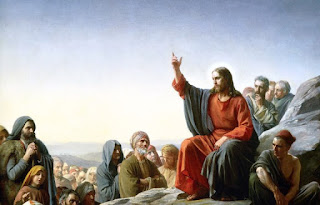
In ancient Jewish tradition, when a rabbi “sits down” after reading the Scriptures, it means he is about to give a homily (note 3). Thus, in the Sermon on the Mount, Jesus “went up the mountain, and after he had sat down, his disciples came to him [and] he began to teach them” (Mt 5:1-2). It’s not hard to picture how electrifying the atmosphere is when Jesus sits down in the synagogue. Anticipation is keeping everyone wait. With a little Hollywood hyperbole, we can almost see them huffing and panting under the weight of suspense. The silence is deafening; one can hear a pin drop. But deep in the hearts of those watching closely Jesus’ every move, speculations and murmurs are rising like a tidal wave: Isn’t this the carpenter, the son of Joseph and Mary? Don’t we know his brothers and sisters very well (cf. Lk 6:22, Mk 6:3)? What is he going to say?
What he says next, according to Luke, is a very brief statement: “Today this scripture passage is fulfilled in your hearing” (Lk 6:21). Need he say any more? Here he is, finally, the Messiah promised by Isaiah’s oracle! He has been anointed to bring glad tidings to those living in poverty, which is everyone spiritually speaking; and to perform healing and miracles, which in a very real sense is another way to see Messiahship. As if to prove his words, he leaves his hometown and performs many miracles soon after the synagogue incident (Lk 4:31ff, 5:12-26).
We are the remnant of Jews listening to Ezra’s proclamation of the word of God. This world is our Babylon, our exile. The same word of God is proclaimed to us at every Mass. Do we have the reverence to listen attentively? Are we moved by the Spirit to say in one accord “Amen, amen!” in response to the proclamation? Can we feel the awesome power of the Word that is enough to crush our pride and literally wrestle our bodies down to prostrate to the ground? Do we see Ezra in our Mass celebrant who speaks from a higher ground and makes us mourn and weep?
Notes:
1. See Foundations in Faith, Year C, p.112.
2. New Jerome Biblical Commentary 43:4.
3. Dr. John Bergma, Everlasting Jubilee, Franciscan University of Steubenville Summer Conference, 2018.
Thursday, December 16, 2021
A Sword Will Pierce Your Own Soul (Luke 2:35)

Piercing indeed is the pain of not understanding your own child. But that was only one of many piercing pains Mary had to suffer in order to help Jesus accomplish the Father’s plan of salvation.
Conveniently located near the Galleria Termini, the Basilica of Saint Mary Major, built in the 5th C to commemorate the Council of Ephesus’ (431 AD) proclamation of Mary as the Mother of God, sat gracefully like an affable old lady, greeting every pilgrim who came east from Vatican City to admire her ancient and imperial Roman architecture, magnificent art works and mosaics, and rich collection of ancient burials (source: https://en.wikipedia.org/wiki/Santa_Maria_Maggiore#Architecture).
Visiting this largest Marian church in Rome was one of the highlights of our family’s pilgrimage to Rome in 2007. A bitter chill greeted us as we got off the bus at the Termini. Armed with Mediterranean humidity and swirling winds, the Roman winter had its way of eating into your bones to cause you great discomfort. Snow was falling - an unusual sight at this time of the year - but accumulation was negligible. Christmas was in the air everywhere we turned. After a short and brisk walk in the cold, our family arrived at the Basilica to celebrate the Feast of the Holy Family.
Fourteen years had passed us by since our family’s visit at Saint Mary Major. In between, we managed to return to Rome together as a family for one more visit in 2012, on the last leg of a cruise trip. Celebrating the Feast of the Holy Family this Sunday brings to mind once again our first experience of the “Eternal City”, especially our trip to Saint Mary Major as a family.
As parents, we owe it to our children to guide them to become the best persons that they can be. For the parents’ guidance to be effective in achieving its lofty goal, the children also owe it to their parents to respect and obey their instructions and orders. This reciprocal filial relationship, built on love, mutual understanding and trust, is crucial for establishing a loving and happy family. On this Feast of the Holy Family, the gospel reading might have left some people wondering if this foundational filial relationship was lacking in the Holy Family.
It’s hard to believe that people would doubt even the Holy Family! But their doubt is not without reason. They are puzzled by the behavior of the adolescent Jesus, which might be fitting for a self-seeking, freedom-craving teenage rebel, but not quite for the Son of God, who in his own teaching demands righteousness and perfection from all children of God because “your heavenly Father is perfect” (Mt. 5:48).
Obviously, this cannot be the case. If this accusation against the adolescent Jesus had been true, then he would have violated his own divine commandment, i.e., honor your father and your mother. What really happened is that Mary tells her son he should have stayed close to his father, Joseph; to which Jesus replies: “I must be in my Father’s house” (Luke 2:49). What Jesus is saying to his mother is that his Father is not Joseph. Like all fathers on earth, Joseph’s fatherhood is only a pointer, pointing us to God, our Heavenly Father. It is even more so for Jesus, who is God the Father’s only Son. Also, the Temple is the Father’s house, which is where Jesus has been the whole time when his parents went looking for him. In other words, what seems like Jesus’ filial disobedience is in fact his expression of a higher filial obedience to the Father.
The main message that Jesus wants us to learn from this story is that ultimately the human family is only a transient pointer, pointing us to the Family of God, which already is present in the Church. This is why the church faithful must love each other as brothers and sisters. Like all the good things in this world that God gives us, our family is important and necessary for our good, both physically and spiritually. But we must not allow ourselves to become attached to it, and make the mistake of seeing it as the be-all and end-all. Such a mistake will cause us to overlook the real reason why family exists in the first place, which is to point and bring us to the Family of God. This is why Jesus says, “For I have come to set a man against his father, a daughter against her mother…Whoever loves father or mother more than me is not worthy of me, and whoever loves son or daughter more than me is not worthy of me” (Mt 10:35-37).
Let’s conclude this reflection with a few more words on Jesus’ mother, the person in the story who took the blunt of Jesus’ seemingly offensive behavior. From this story, we see one more reason why we should love the Blessed Virgin Mary and honor her as the model and exemplar - her strong faith. Imagine living with God day-in-and-day-out, doing what you can as His mother to help Him accomplish His divine plan, which you don’t really understand! Not only does it take a strong faith, the experience also can be very painful, as has become evident in this childhood story of Jesus. Now we can understand better the words of Simeon who, moved by the Spirit, told Mary “a sword will pierce your own soul” (Luke 2:35). Piercing indeed is the pain of not understanding your own child. But that was only one of many piercing pains she had to suffer in order to help him accomplish the Father’s plan of salvation.
Monday, August 2, 2021
God Speaks Only One Word in the Whole Bible
And when the long-anticipated Christ event finally arrives, it often catches us completely by surprise: it comes with a theological significance and finality no scriptural readers could have expected.
“Through all the words of Sacred Scripture, God speaks only one single Word”, and that Word is Jesus (CCC 102). The Church Fathers also taught that “one and the same Word of God extends throughout Scripture, that it is one and the same Utterance that resounds in the mouths of all the sacred writers” (St. Augustine, En. In Ps 103, 4, 1:PL, 1378). Personally, I like Pope Benedict XVI’s eloquent expression of this concept. He considers the Sacred Scripture, which is inspired by the Holy Spirit and written by many different sacred writers, “a symphony of the word, a single word expressed in multiple ways: a polyphonic hymn” (Verbum Domini 7). Jesus himself says just as much in his encounter with the two disciples on their way to Emmaus. He interprets to them what “all the scriptures” say about him, “beginning with Moses and all the prophets” (Lk 24:27).
The Church has always read the Scripture on the understanding that the whole book is about Christ and points us to him. If something in the Scripture, especially in the Old Testament books, reminds us of Christ or bears resemblance to something he does or teaches in the Gospel, don’t see it as just an isolated “coincidence”. The resemblance or connection is often the Divine Author’s extraordinary literary expression, an integral part of His awe-inspiring narrative, meant to enlighten our mind, edify our faith, and draw us deeper into God’s unfathomable love and mystery. More importantly, their relationship is often sequential, one leading to the other, anticipating and heralding the final and definitive act in Christ. When the long-anticipated Christ event finally arrives, it often catches us completely by surprise: while the resemblance to the harbinger OT event is there, it comes with a theological significance and finality no scriptural readers could have expected.
A good case in point is this Sunday’s readings. Both Prophet Elisha and Jesus are the architect of an incredible miracle. Elisha orders his servant to use “twenty barely loaves made from the first fruits, and fresh grain in the ear” to feed a hundred men (2 Kgs 4:42). When the servant objects because Elisha’s order seems so impossible, Elisha doubles down and promises that “They shall eat and there shall be some left over” (v. 43). The miracle happens just as Elisha has promised. In the gospel reading, Jesus orders his disciples to feed 5,000 men, which Philip considers as a mission impossible. “Two hundred days' wages worth of food would not be enough for each of them to have a little”, he protests (Jn 6:7). But the mission, seemingly impossible for Philip, is miraculously completed by Jesus using “five barley loaves and two fish”. When all said and done, everyone is full and leftover fragments collected are enough to fill twelve wicker baskets (Jn 6:9-13).
While both miracles are impressive and look similar, Jesus’ story is one that emerges from a Passover background. Central to the Feast of Passover, as we know well, is food consumption – the eating of the Passover lamb and unleavened bread (Ex 12:1-20). In ancient Jewish tradition, sharing meal is more than just a basic biological need driven by human appetite; it symbolizes unity and communion among the partakers of the meal. More importantly, its liturgical expression in relations with God communicates a divine will to strike a relationship of intimacy with the human party, as was the case in the ratification of the Mt. Sinai covenant, when Moses, Aaron, Nadab, Abihu together with the seventy elders of Israel went up the holy mountain where they “beheld God, and they ate and drank” (Ex 24:11; Theological-Historical Commission, The Eucharist, Gift of Divine Life, p.103). With this ancient Jewish tradition in mind, we recognize in Jesus’ miracle an added layer of mystique and significance: It points us to the unity, communion, and intimacy of the Eucharist.
Following the principle that one and the same Word extends through the Scripture, we can safely conclude from these two readings that Elisha’s multiplication of the loaves is a prelude or prefiguration, if you will, of Jesus’ multiplication of the loaves in John 6, pointing us to something bigger, more significant and definitive that Christ will bring. What’s that something? Note that Jesus’ multiplication of the loaves is strategically placed immediately before his extensive discourse on the “bread of life” in 6:35-59, which is by all accounts a discourse on the Eucharist (Ignatius Catholic Study Bible New Testament on John 6:1-14). Therefore, the two episodes can be seen as John’s one-two punch that introduces us to “the source and summit of the Christian life” – the Eucharist (CCC 1324).
In summary, it’s fair to say that Jesus’ multiplication of the loaves is prefigured by Elisha; its meaning and significance revealed and magnified by his discourse on the bread of life; its institution as a Sacrament liturgized in the Last Supper; its celebration faithfully carried out by the Church, his spouse. All of this has been mysteriously scripted by the sacred writers over the years in the course of the human history, under the inspiration of the Divine Author; and is finally “finished” by Jesus on the Cross, where the Body of Christ, the Heavenly Bread lovingly placed on a wooden holder for our consumption, is hung for all to behold and adore (Jn 19:30). Thus, the whole human history that has gone so wrong because of “the fruit of the tree” in the beginning, is finally set aright by the divine fruit of the tree – Christ on the Cross (Genesis 3:3).
Saturday, June 26, 2021
Summons
God’s summons to each one of us is ringing true in our hearts, daring us to respond, each in our own way.
Amaziah’s contempt is unmistakable when he calls Prophet Amos a mere “visionary” and orders him to leave Bethel to “earn your bread by prophesying” in Judah (Am 7:12-13). Bethel is where Amaziah serves his priesthood, which, sadly, he probably sees as a means for earning his bread. It is embarrassing to recall, but Amaziah’s words reminded me of how I had once offended my spiritual advisor many years ago. Yes, believe it or not, I said something similar although I meant no contempt!
I was a second-year foreign student then at the University of Windsor, still learning the ropes when it came to the English language. A typically rebellious, liberal-minded, and anti-establishment unbeliever from the free-swinging, individualistic, rock ‘n roll days of the early seventies, I nonetheless had begun to acquire some interest in knowing the Gospel due to the influence of my peers at the Chinese Catholic Community in Windsor. Conveniently located in the south end of the campus, right beside the Ambassador Bridge to Detroit, was the Assumption Chapel, the center of the campus ministry of the Assumption University. That’s where I met my spiritual advisor, the pastor in charge of the Chapel and its campus ministry. He took very good care of all foreign students and was very kind to me.
Our first private counselling session was for discovery: just getting to know each other. I told him my heart wasn’t quite at peace; it was full of youthful worries about my study and future career. He in turn told me his own background and how he became a priest. “How nice!” I blurted out, “Your career is all set. You don’t have my worries.” I could tell he was a little taken aback by my impromptu remarks, but overall, the meeting still went well.
Following the meeting, I rehashed and dissected the whole conversation every which way, sensing that something must have gone amiss. I even consulted a Catholic friend. Eventually I realized my terrible mistake of calling priesthood a “career”. It was partly a language issue - a misuse of word - and partly a poor understanding of the nuances of the Catholic priesthood. Of course, priesthood is really a vocation; a noble, selfless and courageous commitment in response to God’s calling; but never a “career”, nor just a way to “earn your bread”, as Amaziah says so contemptuously of Amos’ prophetic ministry in the first reading.
I promptly called up my spiritual advisor and apologized to him profusely. Ever so kind and gracious, he said he knew I meant no harm. If my encounter with him got off to a rocky start, our relationship proved to be a close and lasting one. In Easter 1977, he baptized me and admitted me into the Catholic Church. Looking back, that moment in the Assumption Chapel when he poured water from the baptismal font on my head and then anointed me with oil and the power of the Holy Spirit was a thousand times more significant than my convocation two years later, which ironically had been my original and only reason for leaving Hong Kong to study in Windsor. A few years later, my spiritual advisor gave up the comfort of living in North America and went to Colombia to serve the poor and underprivileged. And there he remains until now.
When one reads St. Paul’s summary of “the riches of [God’s] grace that he lavished upon us” in the 2nd reading, it’s easy to understand why holy people like my spiritual director would choose to surrender their personal wants and direct their every thought, word and action to the service of God’s Kingdom through priesthood. “[H]e chose us in him, before the foundation of the world, to be holy and without blemish before him”, “he destined us for adoption to himself through Jesus Christ”, “in [Christ] we have redemption by his blood” – just to name a few (Eph 1:4, 5, 7). Who in their right mind – I say this literally, for the human mind is not right until it’s fully aligned to see God and worship Him – would hesitate to proclaim such good news to the best of their abilities? Those whose personal and circumstantial situations allow may even choose to do so unreservedly and radically through priesthood.
“Will you come and follow me if I but call your name? Will you let my love be shown? Will you let my name be known…” God’s summons to each one of us is ringing true in our hearts, daring us to respond, each in our own way. For a precious few, like the Twelve summoned by Jesus in this Sunday’s gospel, God’s summons demands a radical personal response, a complete surrender to Him for the love of others, that might entail taking “nothing for the journey but a walking stick – no food, no sack, no money in their belts” (Mk 6:8). In the case of my spiritual director, it meant leaving behind his family, friends, and a safe and comfortable life in North America and risking his own life in order to serve the poor and underprivileged in a country torn by years of social unrest, violence and internal strife.
Will you come and follow me if I but call your name? God’s summons rises in crescendo and dissolves into a whisper in the midst of the ebbs and flows of our daily life. Nagging and persistent, it’s a powerful voice that can be ignored but never forgotten. In Windsor, His summons came in a totally unexpected way. So many years later, it still does – in different forms and with even more urgency.
Friday, April 9, 2021
我們復活後還會吃喝嗎?
這是我為今年復活第二主日所寫的反思。不是所有宗教都一樣,耶穌跟隨者深信在末日人將復活。怎樣復活?真的化腐朽為神奇?請看看!
我們不能說復活是一個可以用實證或個人存在經歷來理解的經驗。我們很難想像我們的身體有朝一日不但會,而是一定要在死後「復生」。
一個身體如果經已腐化,並已溶解為先前已存在的物質,又怎能恢復其原本的形態(假如這就是聖經所指的「復活」的話)?試想想:若我們死後,靈體能繼續存在,住在天主永恆的國度裏,活在福樂中, 不是挺好嗎?為甚麼聖經教導我們必須重新取得肉身?靈魂與身體重新結合,意味著人要存在於時空的秩序裡,和要受到官感上的限制;這不是會阻礙我們靈魂的自由和靈性的清晰嗎?復活是否表示要重返普通生物般的生活?(復活的基督和門徒們一起吃喝,看來似是證實了這一點(參照 若 21:12 -13, 路 24:13ff))。在我領洗後多年, 類似的問題曾令我質疑福音裏復活故事的可信性。雖然是教會的訓導, 我那時並不相信死者的復活,是一件壯觀和充滿希望和喜樂的大事。
在本主日福音中復活的記述,基督兩次向門徒展示祂的傷痕 — 第一次,多默不在場,然後是當他回來時。這兩次顯現本身並不足夠回答以上所有的問題,但也足以給我們一個好機會去研究其中的一些問題,特別是有關復活後身體的特性的問題。
首先是關於耶穌復活後身體上的傷痕。我們可否從耶穌這次顯現來斷定肉身所受的傷害,會影響復活的身體,而且復活後它們依然完整無缺?若這是真的,為那些寄望復活能給他們一個完美身體的人,這提議一點也不吸引!對那些失去了牙齒,連骨頭也靠螺絲牢固的冰棍球員們,他們可回復健康和重獲一個完整的身體的唯一希望,也煙消雲散了!此外,耶穌後來在提庇黎雅海邊及在厄瑪烏路上給門徒們的顯現又如何呢 (若21: 1ff, 路24:13ff)?兩次的顯現都涉及飲食。這是否意味著了我們復活後的身體會繼續像普通生物般生活?實在有很多問題有待解答!
當有疑難時,我總會求教於我少數幾位導師中其中的一位—教宗本篤十六世。他的答案是什麼?「復活的上主的三個表現 — 顯現、講解、同吃共飲 — 是有連貫性的;這是祂證明自己還活著的方式」(納匝肋人耶穌卷一 271頁)。換句話說,復活的基督不是因為需要食物的滋養而進食,而是因為祂要門徒們知道祂確實戰勝了死亡,祂還活著。說得真好!但吃了的食物往那兒去了?天使聖師聖多瑪斯.亞奎納有答案:它已溶解為以前已存在的物質 (神學概要, I.238)。也可以用同樣解釋去看他的傷痕。它們顯現於復活的身體上不是必需的,而是為了門徒們的需要。
許多基督徒,包括我在內,常常無法瞭解逾越奧蹟所釋放的龐大力量。耶穌那獨一無二,前無古人後無來者的救贖行動,把自亞當厄娃犯罪以後,撒旦對人類的壓制粉碎淨盡,澎湃的救恩藉此傾流如注。我們的罪不僅被天主羔羊的寶血所贖;連那可腐朽及經常與靈性作對的肉身,在末日因耶穌復活的力量,也將經歷一個徹底的轉變和更新 (參照 羅7:18-19; 神學概要, I.167)!聖保祿在討論復活的身體這議題時,他明智的觀察是:「播種的是可朽壞的,復活起來的是不可朽壞的;播種的是可羞辱的,復活起來的是光榮的;播種的是軟弱的, 復活起來的是強健的;播種的是屬生靈的身體,復活起來的是屬神的身體」(格前15:42-44)。
在第三天 - 復活主日 - 耶穌的復活改變了一切!第三天也是第八天,新一週的第一天。這一天的神學意義極其重大。聖保祿甚至說,「假如基督沒有復活,那麼,我們的宣講便是空的,你們的信仰也是空的」(格前 15:14)。
容我解釋這沉重的要點。如果第一週 (或首七天) 帶來了第一次的創造 (即這世界,其創造在《創世紀》有詳述) ,第二週,由第八天展開(也是第三天, 復活的那天) ,引進了新的創造,我們作為天主的兒女也是這新的創造的一份子。因耶穌的復活,我們自然的身體也會在末日復活,並分享耶穌復活了的身體那光榮的特性:神光、神速、神透、神健 (神學概要,I.168; 天主教教理 645)。這些特性已在耶穌復活後的顯現中展示出來,包括本主日的福音。在那天,被靈性化及光榮化的身體將完全屬神,並與靈魂恢復完美及和諧的結合 (聖若望保祿二世, 1981年12月日 公開接見)。
正如上主所應許的,這一切都會實現:「看,我已更新了一切」(默 21:5)。在那天,一切都會恢復原來的美麗,並藉著基督與天主完全重歸和好,包括人的身體 (參照 哥1:20)。這真的是一個全新的天地。「以後再也沒有死亡,再也沒有悲傷,沒有哀號,沒有苦楚,因為先前的都已過去了」(默 21:4)。
Friday, March 26, 2021
Will We Still Eat and Drink on Resurrection?
Does this mean our risen bodies will continue to live biologically? So many unanswered questions!
Resurrection is not an experience we can claim to know empirically and existentially. It is hard, if not impossible, to wrap our heads around the idea that one day our bodies will and must “rise” again after death.
How is it possible for a corrupt body that has dissolved into preexisting matter to regain its original bodily form (if that’s what the Bible means by “resurrection”)? Think about it: Isn’t it pretty good if we could continue to exist spiritually after death and live in the blessedness of God’s everlasting kingdom? Why then does the Bible teach the necessity of regaining our bodily form? Will rejoining the body, which must exist in the temporal and spatial order and is subject to the limitations of senses, impede the freedom and spiritual clarity of our soul? Does resurrection signify a return to biological life (which appears to be the case for the risen Christ who ate and drank together with his disciples (cf. Jn 21:12-13, Lk 24:13ff))? For many years after my baptism, questions such as these had made me question the credibility of the resurrection stories in the gospel. I was unconvinced that the resurrection of the dead was a cosmic event of hope and joy, even if it was a Church teaching.
The resurrection account in this Sunday’s gospel, in which the risen Christ shows his wounds to his disciples twice - first in Thomas’ absence, and later when he returns - doesn’t answer all the questions above. But it does give us a good opportunity to examine some of them, especially those pertaining to the properties of the resurrected body.
First of all, the wounds on Jesus’ risen body. Are we to conclude from this appearance that the inflictions suffered by the biological body will somehow affect the risen body and remain intact even after resurrection? This cannot be a very enticing proposition for those hoping the resurrection would give them a perfect body! For hockey players living with no teeth and broken bones secured by screws, their only hope of regaining a healthy and complete body has just gone up in smoke! And what about Jesus’ subsequent appearance to his disciples on the seashore of Tiberias and his appearance to the two disciples on the road to Emmaus (Jn 21: 1ff, Lk 24:13ff)? Both appearances involve the consumption of edibles. Does this mean our risen bodies will continue to live biologically? So many unanswered questions!
When in doubt, Pope Benedict XVI is one of the few mentors to whom I always turn. His answer? “Appearing, speaking, and sharing meals: these three self-manifestations of the risen Lord belong together; they were his ways of proving that he was alive” (Jesus of Nazareth I, p.271). In other words, the risen Christ ate not because he needed the nourishment of the food, but because he wanted his disciples to know that he had truly overcome death and was alive. Makes sense! But where did the food go after consumption? The Angelic Doctor has the answer: It was dissolved into preexisting matter (The Compendium of Theology, I.238). The same explanation is applicable to his wounds. They show on his risen body not because they must, but because the disciples need to see them.
What many Christians have often failed to fully comprehend, myself included, is the awesome power unleashed by the Pascal Mystery. The outpouring of salvific grace as a result of Jesus’ single, never-before-and-never-after redemptive act has truly rendered Satan’s stranglehold on humanity since the fall of Adam and Eve completely powerless. Not only have we been redeemed from sin by the blood of the Lamb of God; the body, corruptible and often in conflict with the spirit as it is, will also go through a complete transformation and renewal on the Last Day by virtue of the power of Jesus’ resurrection (cf. Romans 7:18-19; The Compendium of Theology, I.167)! As St. Paul has wisely observed in addressing the issue of the risen body: “It is sown corruptible; it is raised incorruptible. It is sown dishonorable; it is raised glorious. It is sown weak; it is raised powerful. It is sown a natural body; it is raised a spiritual body” (1 Cor 15:42-44).
On the 3rd day – the Easter Sunday – Jesus’ resurrection has literally changed everything! The 3rd day is also the 8th day, the first day of a new week. The theological significance of this day just cannot be overstated. St. Paul would go so far as to say, “And if Christ has not been raised, then empty (too) is our preaching; empty, too, your faith” (1 Cor 15:14).
This is heavy stuff, but let me explain. If the first week (or the first 7 days) brings the first creation (which is this world, whose creation has been detailed in the Book of Genesis), the second week, launched by the 8th day (which is also the 3rd day, the day of resurrection), ushers in the New Creation, of which we, the children of God, are a part. As a result of Jesus’ resurrection, our natural bodies will also be raised and glorified on the Last Day to share the glorious properties of Jesus’ resurrected body: impassibility, clarity, agility, and subtility (The Compendium of Theology, I.168; CCC645). Such properties are already on display in Jesus’ post-resurrection appearances, including in this Sunday’s gospel. On that day, the spiritualized and glorified body will be fully permeated by the spirit and return to perfect unity and harmony with the soul (St. John Paul II, General Audience, December 9, 1981).
This whole thing must come to pass just as our Lord has promised: "Behold, I make all things new" (Rev 21:5). On that day, everything will be restored to its original beauty and fully reconciled to God through Christ, including the body (cf. Col 1:20). It’s truly a brand-new world. “There shall be no more death or mourning, wailing or pain, (for) the old order has passed away” (Rev 21:4).
The Word of God Is Love Not Violence
Just as Isaiah’s nakedness doesn’t make him a flasher; Jesus’ destructive act doesn’t make him a violent person.
“Lord, you have the words of everlasting life” is the response to the Psalm reading for this Sunday. The Psalm passages are quoted from Psalm 19 – my favorite psalm.
Psalm 19 begins with a beautiful, high-spirited exaltation, paying tribute to God’s magnificent creation that speaks. Speaks? Yes, God’s creations – the sun and the moon, the sunrise and the sunset, the flowers and the trees, the mountains and the valleys – speak; using a language that “proclaims its builder’s craft”; communicating a message that imparts knowledge and wisdom; uttering a sound that cannot be heard and yet resonates loud and clear “to the ends of the world” (cf. Ps. 19:2-4)! What the psalmist is extolling is the word of God; a word that is “perfect”, “true” and “just” (Ps. 19:8-10).
Earlier in the first reading, the same word, pronounced by God in the midst of a theophany as part of His covenant with the holy people on Mount Sinai, is solemnly promulgated: delivered through Moses, the intercessor between God and His people; given to Israel, who promises with one voice to “do everything that the Lord has told us” (Ex 24:3); and decreed in the Decalogue, which means literally the “ten words” or the Ten Commandments (CCC 2059-2060). Written on two separate tablets – three on one and seven on the other – these are words of love: “the first three concern love of God, and the other seven love of neighbor” (CCC 2067).
I always remember what my professor taught me when I was taking a course on the Old Testament at the St. Augustine Seminary of Toronto. He said the Greeks lived in a world of numbers, but the Israelites lived in a world of word, dynamic and prophetic. Word to them is electricity to us – a force that makes things happen and is indispensable. At this point, every reader who is human and breathing would probably ask, having gone this far in reading the Bible, “Who is this word”?
John began his gospel by tackling this question head on: “In the beginning was the Word, and the Word was with God, and the Word was God” (Jn 1:1). The Word is further identified as Christ incarnate, who “became flesh and made his dwelling among us” (Jn 1:14). But if Jesus, the Word of God, is “perfect”, “true” and “just”, as the Psalm reading tells us he is; and if the Decalogue - the 10 words of love - also finds its origin in him; how are we supposed to understand the act of violence committed by the same Word of God in this Sunday’s gospel? What Jesus did was unambiguously violent: “He made a whip out of cords and drove them all out of the temple area, with the sheep and oxen, and spilled the coins of the money changers and overturned their tables” (John 2:15).
Let’s be very clear. It will be ignorance to the extreme for anyone to suggest that the temple cleansing story is meant to justify the use of force. Let’s face it; it would take a radically different direction for Jesus, whose ministry and message throughout the gospel are all about love, peace, and humility, to suddenly promote violence. Those who read the Johannine narrative in context can’t possibly miss its culminating theme, namely, that the temple is a sign of Christ’s body, which will be destroyed and raised up in three days – an allusion to the Cross and the Resurrection (Note 1). This is how Jesus explains his action: “Destroy this temple and in three days I will raise it up” (John 2:19).
Still, why is it necessary for him to resort to a violent act to communicate his theological message? To truly understand Jesus’ action, we must keep in mind his prophetic ministry and how it works. If I were to pick 10 OT promises that any scriptural reader must remember at all times, this one, revealed by Moses, would be one of them: "A prophet like me will the LORD, your God, raise up for you from among your own kinsmen; to him you shall listen” (Dt. 18:15). Turned out, the promised prophet is Jesus – the Prophet of all prophets.
The OT prophets came from, shall we say, a very special species. They were mostly shunned by the very people they were summoned to enlighten: kings, political leaders, and religious authorities. Sometimes they had to do very unusual things in order to drive home their messages. Hosea married a harlot in order to show Israel God’s displeasure with its infidelity. Ezekiel was asked to eat bread baked on cow’s dung in order to forewarn the Israelites of the abomination of having to eat unclean food while in exile (Eze 4:12-15). God’s instruction to Isaiah was even more bizarre: He was asked to walk naked and barefoot through Jerusalem for 3 years! The prophet followed God’s order to a tee, not because he enjoyed exposing himself – God forbid! - but because he needed to convince the Judeans of their futile attempt to court the Egyptians and Ethiopians. These nations were bound to be defeated by the Assyrians and taken away as captives in their nakedness (Is. 20:3-6).
Given Jesus’ prophetic ministry and the way it works, it’s fair to conclude that there’s a deeper significance to Jesus’ destructive act in the cleansing of the temple. Just as Isaiah’s nakedness doesn’t make him a flasher; Jesus’ destructive act doesn’t make him a violent person. Both acts are prophetic, meant to communicate a prophetic message. In Jesus’ case, the message is to warn the Jews of the violent destruction of the temple (which happened in 70 A.D.). The temple is his body. The destruction of a temple made by human hands is the beginning of the new Temple in heaven. It’s a sign pointing to the Cross and the Resurrection. He himself is the new Temple, the Body of Christ, the Church. Through Christ, a new way of worshipping God is about to begin, when all peoples are gathered and united in the sacrament of his body and blood, worshipping God “in spirit and truth” (Jn 4:23, note 2).
Note 1: See Ignatius Catholic Study Bible New Testament on John 2:19.
Note 2: See Jesus of Nazareth – Holy Week, pp. 21-22.
Madness or Love? It’s all in the Eyes of the Beholder
Call him a madman, a weirdo, or anything you want; the reality is, the fire in Paul’s heart, ignited by the Spirit, is something people won’t understand unless they are prepared to welcome the same Spirit into their hearts.
A friend of mine has a rather unusual position on the issue of parenthood. In his view, the world we live in is full of sorrows and tribulations. He thinks bringing innocent children into this world of toils and snares is both unfair and cruel because you are effectively making them suffer against their will; which is also why he and his wife have decided against having children. His view is unusual but not uncommon these days in a world captivated by the culture of death. Obviously, this is not what the Church teaches. The Church has always encouraged parenthood. It’s considered the culmination of the married couple’s expression of love, which gives rise to a selfless and generous participation in the creative work of God (CCC1652).
My friend’s pessimistic life view will find resonance in Job’s words in this Sunday’s first reading. “Is not man’s life on earth a drudgery? Are not his days those of hirelings?”, Job asks as he struggles to understand the sudden onslaught of misfortunes that have left his life in tatters and complete disarray (Job 7:1). Abandoned and mocked by his friends - even by his wife - Job begins to see life as a “drudgery”; a futile and meaningless exercise that one must grudgingly put up with. This is a very dark mindset that often drives people desperate for a way out to end their own life or, in my friend’s case, avoid starting a new one. In fact, ending his life is exactly what Job is counseled to do. “Curse God and die”, his wife yells at him in disgust (Job 2:9).
A suicidal mind is, of course, not what the Bible wants from us. After many difficult struggles; heated arguments with friends, who openly question his claim of innocence; and serious intellectual reflections that include a heart-to-heart discussion with God, Job finally regains his trust in God. In the end, he is convinced that God is always in control in spite of the inexplicable personal misfortunate that befell him; and that God, in His unfathomable wisdom and omnipotence, has a plan that is simply too profound for the human mind to fully comprehend.
God’s plan certainly is difficult to comprehend, but Job’s decision to continue to trust God in spite of personal sufferings and devastations is not any easier to understand for many people. It takes faith and humility. When I first read Job while taking a university course on Medieval Philosophy, I hastily wrote the book off as “blind faith”. As a young and aspiring “philosopher”, I considered it an affront to my rational mind. But what goes around comes around. So many years later – now that I’m done studying, done raising children, done pursuing a career, done admiring the philosophers, done ridiculing the Bible – I find myself embracing Job’s position unreservedly. I honestly believe that of all the explanations and solutions put forward by all the great thinkers, philosophers and theologians alike on the issue of suffering, Job’s is the only sensible one.
What have changed? Just one thing really: my heart. Where the person gloriously enthroned in there used to be me, now it is Jesus - him and only him, front and center, unreserved and all-consuming. That’s it? That’s it. The change didn’t come easy. But when it did, repentance followed; so did faith and humility and a rush for action to proclaim the unspeakable joy of knowing Christ. The experience was just overwhelming, consuming my whole being, pushing me hard to make up for lost time.
The urge was irresistible - almost panicky. It was a powerful awakening that “cut to the heart” (Acts 2:37). Like the three thousand who heard Peter’s gospel message and received baptism on Pentecost, the urgency just dawned on you powerfully. As though your life depended on it, you blurted out loud desperately: “What are we to do?” (Acts 2:37). No one can express the urgency I experienced better than Paul when he says in this Sunday’s 2nd reading, “If I preach the gospel, this is no reason for me to boast, for an obligation has been imposed on me, and woe to me if I do not preach it!” (1 Cor 9:16); and again elsewhere, “For the love of Christ compels us” (2 Cor 5:14).
For many people, Paul and people like Job should simply be written off as madness. Felix, the Roman governor, was one of them. "You are mad, Paul; much learning is driving you mad", he shouted after hearing Paul’s spiritual conversion story and his defense against the charges made by the Jews (Acts 26:24). Call him a madman, a weirdo, or anything you want; the reality is, the fire in Paul’s heart, ignited by the Spirit, is something people of this world won’t understand, unless they are prepared to welcome the same Spirit into their hearts.
People call what they don’t understand “madness”. For them, Jesus who preaches in the synagogues and performs healings tirelessly in various villages in this Sunday’s gospel may well be just another madman rejected by the world – one who “came to his own home, and his own people received him not” (John 1:11). For my friend, parenthood may well be just another form of madness. But if faith in God, proclaiming the gospel, and promoting the culture of life are different forms of madness; madness is what we must choose.
Saturday, December 26, 2020
At the Nativity Every Jaw Should Drop

When the Magi come to pay homage to the powerless infant in the manger, the time has come for Jerusalem to take the center stage, and for Daughter Zion to become the Bride of Christ.
Epiphany means “revelation”. The Solemnity of the Epiphany is historically associated with three “revelations” of Christ: to the Magi, the foreigners coming to Jesus, in a manifestation of the universality of his salvation; at his baptism in the Jordan, where the Trinitarian mystery is revealed; and at Cana in Galilee, where the overflowing joy of his nuptial union with the Church is highlighted through the first of his signs (note 1). All three revelations remind us of the immensity of God’s saving love in Jesus as the Christmas mystery continues to unfold.
What makes the Bible such a fascinating book to read is its uncanny ability to continue to surprise us at every turn of its narrative of the long history of salvation. When the fullest of time has come for God to reveal Himself to the world in the most definitive way, He chooses not to show up authoritatively – the way He appeared to Abraham, as three men standing at the entrance of his tent (Gen 18:1-10); or present Himself mysteriously - to Moses “in fire flaming out of a bush” (Ex 3:2-3); or exhibit His omnipotence terrifyingly - to Israel in “peals of thunder and lightning…and a very loud trumpet blast” on Mount Sinai (Ex 19:16). In the most unexpected and self-deprecating manner, He chooses to manifest Himself in a powerless and defenseless infant, “born of a woman, born under the law”, “laid in a manger because there was no room for them in the inn” (Gal 4:4, Lk 2:7).
I don’t know about you. For me, the Nativity is not only a timeless and beautiful story, but also the most shocking twist and turn in all of human history. One that the most nerve-wrecking suspense from a Hitchcock movie cannot even come close in comparison. St Paul says every knee should bend at the name of Jesus (Phil 2:10). I say every human jaw should drop to the floor in reflecting on the Nativity!
The surprises are indeed many. Chief among them is the profound mystery of Christ’s incarnation. Who would have thought that of all the ways that God could have used to come to us, He would choose to allow Himself to be restricted by His own creations – space, time, and the human nature? Who would have imagined that the almighty God would put Himself in harm’s way by plunging deep into the undercurrents of human history? Who would have predicted – other than God Himself through His prophets – that He would come into this world through a virgin birth, and make Himself known to the world as a powerless infant in the little town of Bethlehem (cf. Is 7:14, Micah 5:1)?
“And the Word became flesh and made his dwelling among us”, John proclaims the mystery joyfully in the prologue to his Gospel. “The Son of God became the Son of Man so that the sons of men could become the sons of God.” Like everyone else, St. Athanasius’ struggled mightily to understand such a profound mystery, but this definition he coined goes down in history as one that inspires countless theologians, clergy, and laity alike. Christ came not only to redeem us, but also to elevate our human nature to lofty heights unimaginable by any human mind. In so doing, he enables us to partake of God’s divinity, making us the children of God (2 Peter 4:4)! “See what love the Father has bestowed on us that we may be called the children of God. Yet so we are” (1 Jn 3:1)! Dumfounded and in disbelief, John can find no better words to express his amazement.
This has been a powerful reflection on the Epiphany of the Lord. But the jaw-dropping surprise doesn’t stop there. The theme of all three Mass readings is the universality of God’s saving grace. A universality that manifests itself in Jerusalem’s distant future, when “nations shall walk by your light”; when “your sons [shall] come from afar”; when “the wealth of nations shall be brought to you” (Is. 60:3-5).
To St. Paul and the Jews, whose understanding of salvation has been restricted by God’s progressing pedagogy in the Old Testament to mean “salvation for Israel only”, the revelation of the mystery of universal salvation is a very big deal; or, shall we say, another jaw-dropping surprise. It’s a secret that “was not made known to human beings in other generations as it has now been revealed to his holy apostles and prophets by the Spirit, that the Gentiles are coheirs, members of the same body, and copartners in the promise in Christ Jesus through the gospel”. (Eph 3:5-6). When the Magi come to pay homage to the powerless infant in the manger, the time has finally come for the secret to turn into a reality, for Jerusalem to take the center stage in world history, and for Daughter Zion to become the Bride of Christ – the Catholic Church.
Note 1: See Foundations in Faith - Catechist Manual Catechumenate Year B, p. 32.
Subscribe to:
Posts (Atom)