Those who are passionate and serious about writing - unfortunately there just isn't enough of them in this world - will know the meaning of this topic well. After reading and studying the Bible for many years, I'm totally convinced that there is no writer more passionate and serious than God the Divine Writer. When people don't read what the Divine Writer wrote - the Bible - He's understandably sad.
Yes, I've heard it too many times: the Bible is hard to read; it's boring; I don't see its relevance to what I do in my life; it's very unscientific; it's factually self-contradictory in many areas; it's full of violence....Comments such as these usually come from people who don't read the Bible. What about those who do? This is what they say:
"An inexhaustible treasury of heavenly doctrine" - St. Chrysostom in Gen. Hom. xx, 2.
"Fertile pastures and beautiful gardens in which the flock of the Lord is marvelously refreshed and delighted" - St. Augustine, serm. xxvi, 24.
"To live amidst these things, to meditate these things, to know nothing else, to seek nothing else, does it not seem to you already here below a foretaste of the heavenly kingdom?" - St. Jerome, Ep. 53, 10.
"If there's one thing that's capable of changing my life completely, turning me from a rebel against the Church to an apologist, from a life view that's completely self-centred to one that sees life as not worth living unless it's lived as a complete gift of self, it's the Bible!" - Yours truly.
Those who are critical of the Bible have to wonder why the saints are all in one accord in commending it.
I must hasten to point out: I put my comment up there together with the saints' not because I consider myself a saint, but because I'm truly one of those wretched souls who have benefited tremendously from the Bible. But whether a wretch or a saint, one can feel the full force of the Bible only if the Holy Spirit has touched his heart. Without Him, all attempts to read and understand the Bible will be futile.
But what should I do to make sure I have the Holy Spirit's guidance in reading the Bible? you ask. Find the right "tour guide"!
Just like the excursions mentioned in my two "Cruise Trip" posts, it makes a world of difference if an experienced person is there to lead and guide you when you journey through the Bible. It's even better if your guide is an authentic source of credibility, authority, and holiness. Over the years, some excellent "tour guides" I've used include: the Catechism of the Catholic Church, Conciliary documents (Vatican II, etc.), papal writings and pronouncements, and Church Fathers' writings. What all of these documents have in common is that they contain numerous scriptural teachings and insights that really enable the reader to understand the richness and vibrancy of the Bible. The understanding in turn will bring peace and happiness that make the scriptural books appear like "fertile pastures and beautiful gardens".
For beginners, your best "tour guide" is the Catechism of the Catholic Church. What is important is that you have your Bible handy as you read the Catechism. When the Catechism explains a certain doctrine or teaching, it often makes reference to some scriptural passages. Look those up to make sure you understand why the scriptural passages referred to support what the Catechism teaches. This is a rather arduous process; it takes a lot of going back and forth between the Catechism and the Bible. But if you adhere to this approach diligently, I can guarantee that before you are mid-way through the Catechism, you will have become quite a Bible expert! The greatest advantage of this method is that your understanding of the Bible will be rooted deep in the Holy Tradition because the catechetical teachings of the Catechism reflect faithfully the Catholic faith handed down by the Apostles and the Church Fathers over 2,000 years of the Church history.

The heavens declare the glory of God; the sky proclaims its builder's craft (Psalm 19:2). elodocuments is an English/Chinese bi-lingual blog that shares based on the Catholic faith.高天陳述天主的光榮,穹蒼宣揚祂手的化工(詠19:2)。elodocuments 是個用中英語分享天主教信仰的網誌。
Tuesday, August 14, 2012


Friday, August 10, 2012
Cruise Trip Ending in Rome Where It All Began
Perhaps it was the influence of Islam and the ancient Byzantine culture; perhaps the religious separation of the nations from the Latin Church; perhaps the region's isolation geographically from western Europe - whatever the reason, the shroud of mystique covering the Turkey and Greece region tickled my curiosity and imagination as I stood with Josephine on the ocean-view outdoor deck of Celebrity Equinox. Leaning against the waist-high railing, we admired the golden hues of the setting sun on the distant horizon of the Aegean Sea. 
As the ship headed west toward the coasts of southern Italy, we entered into the last 3 days of the itinerary of the cruise: 1 more day at sea, 1 more in Naples, and the last day in Rome where the passengers would disembark. With all passengers on board, the ship was noticeably more crowded, but not so much as to cause any discomfort or inconvenience. Ever so organized and attentive to the needs of the passengers, management of the crew took the opportunity to offer Dessert Extravaganza on the evening before the at-sea day, and then a formal dinner at the magnificent and luxurious Silhouette Dinning Room the following evening.

The at-sea day also meant we had more time to explore the various venues and amenities offered by the ship. By this time of the journey, I had already adopted a certain "daily routine", part of which was waking up early in the morning to exercise on deck of the Lawn Club - a freshly manicured lawn on the highest deck of Equinox with a decidedly country club atmosphere that was just fantastic for outdoor activities. The Oceanview Cafe and Bar was only one deck below, which was where I went for breakfast following morning exercise. I would find a table good for 4 people, open up the book that I had brought specifically for reading during this trip, and wait patiently for the rest of my family to join me. Sometimes they never did. If any family members ever showed up, it would be Jason who was more disciplined and predictable, followed by Josephine. Michelle? Well, it appeared her body clock always mistook lunch for breakfast....

At the port of Naples, we were picked up by Antonio, our driver and tour guide whose slender build, elongated face, slightly protruded teeth and seemingly mindless laughter reminded me of a good childhood friend named Hong Gor. It was simmering hot in Naples. There was not a cloud in the sky. Whatever remnants that remained from the morning haze were quickly burnt off by the rising sun that continued to pick up strength as the day progressed. Antonio, the Italian version of Hong Gor, was a cheerful young man who had just got married, and was extremely proud to be able to work for his new wife who was now his office manager. Driving us up and down the incredibly treacherous roads in the mountainous region of southern Italy, Antonio brought us safely to the scenic Amalfi Coast. While the ocean views of Amalfi were eye-catching and the beauty of its beaches stunning, what really took our breath away was something very humble and unnoticeable that sat in a quiet corner of the town.
Hidden in a curved corner in downtown Amalfi, the Cathedral of Amalfi looked small and was hardly detectable amongst a multitude of tourist shops jockeying for business and people's attention. But as soon as we had climbed its long stairway to reach the front door, we realized that it was anything but small. Standing there at the doorway to greet every visitor was a sign that said, "Welcome to the Cathedral of Amalfi and the crypt with St. Andrew's tomb". St. Andrew? One of the twelve apostles? Indeed he was!! Having visited the house of Mary in Ephesus, venerated the burial place of St. John, and then traced the footsteps of St. Paul in Athens and Corinth, little did I know that our cruise trip would take us to the tomb of St. Andrew
  - Simon Peter's brother who took Simon to see Jesus, the Messiah he had just found (cf. John 1:40-42). Without him, the first Pope of the Church could have been a different person! With my heart filled with thankfulness and my head overcome by incredulity, I did the only thing that was right: kneeling down at the crypt to thank God and St. Andrew for the blessings....
If there's anything I didn't like about Celebrity Equinox, it was their very strong but tasteless coffee, which forced me to let go of coffee for several days. As a result, I was overjoyed when I found a good cup of "American coffee" at a coffee shop in Positano - another beautiful coastal town situated to the east of Amalfi. People say that in ancient Europe all roads began and ended in Rome. So it was with our journey. From Positano Antonio drove us to his home town Sorrento, and from there we took a hydrofoil to return to Naples and our ship Equinox.
By the time we disembarked to Rome, we had already had very blessed encounters with Our Lady and three apostles (St. John, St. Paul, and St. Andrew). On this second visit of Rome - the first one was in 2008 - we paid tribute to Scavi, the catacomb underneath St. Peter's Basilica, where we admired the sacred bones of St. Peter, placed in a crypt no more than 20 feet away from where we knelt. That brought the total number of apostolic encounters to 4! Adding to our blessings were a Sunday morning Mass at Pope John Paul II's new altar and Angelus at noon with the Holy Father, whose books, Jesus of Nazareth I & II, I had just read.

A cruise trip like this for four people was not cheap obviously. But no money can buy the family time that we spent together; and nothing can compare to the blessings that God graciously bestowed on our family during the 15 days in which we as family members got to know one another a little better. At this stage of my life, knowing where I am spiritually and where I once was; upholding a renewed understanding of the true meaning of life and its values; and doing what I've always loved to do - spreading the Good News of Christ; a trip like this really enabled me to come to realize "the breadth and length and height and depth" of the love of Christ (Eph 3:18), who has always been merciful, faithful, and steadfast in leading and guiding me in all these years. With a heart filled with thankfulness, contentment, and great joy, I conclude this sharing at our last stop in Rome, where it all began....


As the ship headed west toward the coasts of southern Italy, we entered into the last 3 days of the itinerary of the cruise: 1 more day at sea, 1 more in Naples, and the last day in Rome where the passengers would disembark. With all passengers on board, the ship was noticeably more crowded, but not so much as to cause any discomfort or inconvenience. Ever


The at-sea day also meant we had more time to explore the various venues and amenities offered by the ship. By this time of the journey, I had already adopted a certain "daily routine", part of which was


At the port of Naples, we were picked up by Antonio, our driver and tour guide whose slender build, elongated face, slightly protruded teeth and seemingly mindless laughter reminded me of a good childhood friend named Hong Gor. It was simmering hot in Naples. There was not a cloud in the sky. Whatever remnants that remained from the morning haze were quickly burnt off by the rising sun that continued to pick up strength as the day progressed. Antonio, the Italian version of Hong Gor, was a cheerful young man who had just got married, and was extremely proud to be able to work for his new wife who was now his office manager. Driving us up and down the incredibly treacherous roads in the mountainous region of southern Italy, Antonio brought us safely to the scenic Amalfi Coast. While the ocean views of Amalfi were eye-catching and the beauty of its beaches stunning, what really took our breath away was something very humble and unnoticeable that sat in a quiet corner of the town.
Hidden in a curved corner in downtown Amalfi, the Cathedral of Amalfi looked small and was hardly detectable amongst a multitude of tourist shops jockeying for business and people's attention. But as soon as we had climbed its long stairway to reach the front door, we realized that it was anything but small. Standing there at the doorway to


If there's anything I didn't like about Celebrity Equinox, it was their very strong but tasteless coffee, which forced me to let go of coffee for several days. As a result, I was overjoyed when I found a good cup of "American coffee" at a coffee shop in Positano - another beautiful coastal town situated to the east of Amalfi.


By the time we disembarked to Rome, we had already had very blessed encounters with Our Lady and three apostles (St. John, St. Paul, and St. Andrew). On this second visit of Rome - the first one was in 2008 - we paid tribute to Scavi, the catacomb underneath St. Peter's Basilica, where we admired the sacred bones of St. Peter, placed in a crypt no more than 20 feet away from where we knelt. That brought the total number of apostolic encounters to 4! Adding to our blessings were a Sunday morning Mass at Pope John Paul II's new altar and Angelus at noon with the Holy Father, whose books, Jesus of Nazareth I & II, I had just read.

A cruise trip like this for four people was not cheap obviously. But no money can buy the family time that we spent together; and nothing can compare to the blessings that God graciously bestowed on our family during the 15 days in which we as family members got to know one another a little better. At this stage of my life, knowing where I am spiritually


Monday, July 9, 2012
Living In the Holy Tradition
The registrants showed up for the first meeting as planned, a good 20 of them, dressed comfortably in casual summer clothes. As expected a few people had to miss the first meeting. It was after all summertime: vacations, visitors, other summer funs and commitments were rightful competition. I had made it clear to them that they should feel no pressure or obligation to attend every meeting as much as I liked them to. For one thing, this was only a pilot project, conducted to "fill in the gap" when my RCIA was in summer recess. More importantly, the course was designed in such a way that each meeting was essentially a self-contained topic of its own. Missing one meeting would not cause the participant any difficulty in understanding the next one.
Admittedly, partly due to the sheer numbers of the participants I normally had to deal with and partly my inability to remember well, I didn't always know the names of the people taking my programs. Not for this group though. All of them had attended either my Catechism Revisited Program or the Bible Study Program before and some of them were good friends from my family groups. The scriptural and catechetical knowledge they had picked up from such activities and their familiarity with my style made it easier for them to understand the materials of this program, which in many ways were more advanced. Needless to say, familiarity also bred mutual comfort.
We began by reviewing what the Church meant by the Holy Tradition. The understanding made it evident that any attempt to receive the revealed truth as it was given by Christ in its entirety to the Church and handed down faithfully by the Apostles and their successors to us must be grounded in the Holy Tradition, which explained why a deep immersion in the Church Fathers' writings and on-going reading of magisterial pronouncements and publications such as Benedict XVI's Jesus of Nazareth was the best way to enable the Church faithful to understand the faith of the divine and universal Church of Christ without deviations and unnecessary detours.
Then, without further ado, we plunged right into the pages of the Holy Father's book, Jesus of Nazareth: From the Entrance into Jerusalem to the Resurrection, full of sweet insight and orthodox understanding of the Scriptures as it was. As I led the class to review and discuss the kingship of Jesus - the topic of our fist meeting - I felt like I was leading them to walk through delightfully a beautiful park full of colorful and exotic plants and flowers! No wonder the Scriptures were "fertile pastures and beautiful gardens in which the flock of the Lord is marvelously refreshed and delighted" to St. Ambrose (note 1); and to St. Jerome the experience of reading them seemed like "a foretaste of the heavenly kingdom" (note 2)!
Summertime to me was the time for preparing and promoting next year's programs, which inevitably involved meetings and lots of administration - not exactly the way I wanted to spend my time. At the same time, I realized such work was unavoidable. I wish I could spend more time to share the joy of reading the Bible, a wish constantly reinforced and heightened by the look of satisfaction exuded happily from the faces of the people fired up by the Holy Spirit to respond to the power of the word of God. By nature quiet and quite an introvert, I must admit I was never of any good in socializing: my hearing would go from bad to worse in noisy public places; my voice, soft and weak in velocity as it was, would get badly drowned out; and my head, devoid of topics for little talks that came so naturally for so many people, would go blank. But for some reason, the moment I stepped up with the Bible in hand to stand behind the lectern in front of a crowd, or stood in the middle of a room filled with people whose attention was generously given to me, I would suddenly feel perfectly at ease and comfortably at home. That was also how I felt standing in the middle of room 203 of CMCC yesterday, surrounded by a small group of people whom I knew intimately by name. Should you decide to join us to share the experience of "walking through a park", don't hesitate to join us next Sunday at 9:15 a.m.! Yes, we have plenty of room to admit some more participants, and absence from the first meeting would not cause you any hinderance.
Note 1: S. Ambrose in Ps. 118, serm. xix, 2.
Note 2: S. Jerome, Ep. 53, 10; PL. XXII, col.549; CSEL. LIV, p.463.
Admittedly, partly due to the sheer numbers of the participants I normally had to deal with and partly my inability to remember well, I didn't always know the names of the people taking my programs. Not for this group though. All of them had attended either my Catechism Revisited Program or the Bible Study Program before and some of them were good friends from my family groups. The scriptural and catechetical knowledge they had picked up from such activities and their familiarity with my style made it easier for them to understand the materials of this program, which in many ways were more advanced. Needless to say, familiarity also bred mutual comfort.
We began by reviewing what the Church meant by the Holy Tradition. The understanding made it evident that any attempt to receive the revealed truth as it was given by Christ in its entirety to the Church and handed down faithfully by the Apostles and their successors to us must be grounded in the Holy Tradition, which explained why a deep immersion in the Church Fathers' writings and on-going reading of magisterial pronouncements and publications such as Benedict XVI's Jesus of Nazareth was the best way to enable the Church faithful to understand the faith of the divine and universal Church of Christ without deviations and unnecessary detours.
Then, without further ado, we plunged right into the pages of the Holy Father's book, Jesus of Nazareth: From the Entrance into Jerusalem to the Resurrection, full of sweet insight and orthodox understanding of the Scriptures as it was. As I led the class to review and discuss the kingship of Jesus - the topic of our fist meeting - I felt like I was leading them to walk through delightfully a beautiful park full of colorful and exotic plants and flowers! No wonder the Scriptures were "fertile pastures and beautiful gardens in which the flock of the Lord is marvelously refreshed and delighted" to St. Ambrose (note 1); and to St. Jerome the experience of reading them seemed like "a foretaste of the heavenly kingdom" (note 2)!
Summertime to me was the time for preparing and promoting next year's programs, which inevitably involved meetings and lots of administration - not exactly the way I wanted to spend my time. At the same time, I realized such work was unavoidable. I wish I could spend more time to share the joy of reading the Bible, a wish constantly reinforced and heightened by the look of satisfaction exuded happily from the faces of the people fired up by the Holy Spirit to respond to the power of the word of God. By nature quiet and quite an introvert, I must admit I was never of any good in socializing: my hearing would go from bad to worse in noisy public places; my voice, soft and weak in velocity as it was, would get badly drowned out; and my head, devoid of topics for little talks that came so naturally for so many people, would go blank. But for some reason, the moment I stepped up with the Bible in hand to stand behind the lectern in front of a crowd, or stood in the middle of a room filled with people whose attention was generously given to me, I would suddenly feel perfectly at ease and comfortably at home. That was also how I felt standing in the middle of room 203 of CMCC yesterday, surrounded by a small group of people whom I knew intimately by name. Should you decide to join us to share the experience of "walking through a park", don't hesitate to join us next Sunday at 9:15 a.m.! Yes, we have plenty of room to admit some more participants, and absence from the first meeting would not cause you any hinderance.
Note 1: S. Ambrose in Ps. 118, serm. xix, 2.
Note 2: S. Jerome, Ep. 53, 10; PL. XXII, col.549; CSEL. LIV, p.463.
Monday, July 2, 2012
Cruise Trip to Istanbul, Ephesus, Athens, Corinth, Naples and Rome
After a 10-hour flight from Toronto Pearson, we landed in Rome at 7 a.m. and headed immediately to the port where our cruise ship, Celebrity Equinox, docked.  The last time and the only time our family had a cruise trip together was 12 years ago at the Caribbean. It was unfortunately a forgettable experience, so much so we thought we would never take a cruise vacation again: the ship was old, its amenities and services uninviting, and its passengers rowdy and rude. We found ourselves virtually "imprisoned" for several days with nothing better to do than counting the minutes and the hours, longing for the freedom of disembarkment.
Not this time.
12 days on board the Equinox flew by like a 12-minute merry-go-round, leaving us dazzled and wide-eyed. When it was all over, we left the ship like four little kids leaving a store full of goodies, clamouring for more of the thrills and the sweet moments that had gone by so swiftly.
For one thing, the ship was almost brand new - no more than 3 years old. It was spacious and well-designed, with 13 decks, beautiful staterooms, magnificent venues, fine dining and entertainments, and pleasing interior colors throughout. The feeling was more like staying in the safe and solid confines of a 5-star hotel than being afloat at sea.
More important, however, were the destinations and excursions carefully planned out and organized by Josephine. We stopped over and disembarked at Santorini, Greece; Istanbul, Turkey; Ephesus, Turkey; Athens/Corinth, Greece; Crete, Greece; Naples, Italy; and ended the trip at Rome. The temptation is to write a page or more for each destination, but to keep the length of this post readable I will discipline myself to show only a few pictures and to share some of the highlights and my thoughts. So here we go!
(1) Glimmering white and blue Santorini - it's so Greek!


(2) Istanbul , formerly known as Constantinople in Roman times, was a historic city I had read so much about: its strategic geographical location that spanned over 2 continents - Europe and Asia; its intense rivalry with Rome to become the centre of the Roman Empire; its ancient landmark "Hagia Sophia" - the epitome of Byzantine architecture and the largest cathedral in the world for nearly a thousand years....It's hard to believe but there we were, my family and I, setting foot on this very ancient city, experiencing the riches of its culture and history. Once a glorious Christian cathedral that showcased the world's largest dome and magnificent Christian paintings and mosaics, Hagia Sophia was taken over by the Muslims in 1453 and was converted into a mosque. Believing that human images would constitute idolatry and blasphemy, they covered up all religious art works with a layer of greyish plaster. As a result, the massive building, now a museum, appeared bare and gloomy. My heart sank as I thought of the grandeur and holiness that had once infiltrated the cathedral structure to render so many religious souls in awe and reverence.
(3) We also toured the Blue Mosque, which was located just next to Sophia; and got on board a ferry that took us to the part of Istanbul where "Europe meets Asia". Knowing the stern and terrifying image that the non-Muslim world had formed, rightly or wrongly, against the Muslim countries especially since 9/11; our tour guide made a point of showing us the secular and westernized life style that the country had chosen to adopt, explaining that the Muslim faith that Turkey believed in was a moderate and inclusive one.
(4) The rest of our trip was like "a prayerful journey to follow the footsteps of St. Paul": the Arcadian Way and the amphitheater of Ephesus where Paul and his companions had survived unscathed the furious riot of the silversmiths who rose against them to protect the goddess of Artemis (Acts 19);
the Areopagus in Athens where Paul debated the Greek philosophers to help them understand that God, who had revealed Himself through Christ, was not an "Unknown God" (Acts 17:16ff);
the ancient city of Corinth where Paul established the Corinthian church and faced accusation by the Jews at Bema (the tribunal, Acts 18:1-17);
the beautiful little port near Corinth from where Paul set sail to Syria, Ephesus and then to Caesarea and Jerusalem where he was arrested and imprisoned (Acts 18:18-22, 21:1ff); and finally to Rome where he was martyred.
(5) While In Ephesus, we also attended Sunday Mass at the House of Virgin Mary, and visited the St. John's Basilica, a once great church built on a 2nd century tomb thought to hold the remains of St. John. Praying at the tomb of the author who wrote the gospel I like the most was a moving experience that mere words cannot describe; a stone I picked up from the area will keep me physically in touch with this great evangelist to whom the 2 letters of John and the book of Revelation are also attributed. Seeing the ruins of the Church of Mary where the first ecumenical Council of Ephesus was conducted in 431 A.D. and the doctrine recognizing Mary as the Mother of God (Theotokos) affirmed was a spiritually stirring experience that I never thought could have happened. Suddenly the very venue of this significant event in the history of the Church that so far had been perceptible only from the pages of my theology textbooks was right there before my very eyes!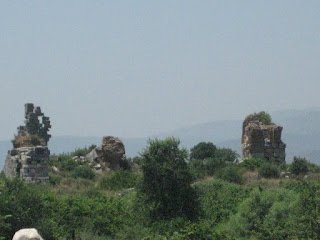
As the cruise trip concluded and we disembarked to Rome, my heart was still hovering over the densely populated coasts and glistening waters of the Mediterranean and Aegean seas, defying space and time to become one in spirit with myriads of people who in the course of time unstoppable had paraded across the stage of history and yet remained vivid and alive in the mysterious faculties of the human mind....

Not this time.
12 days on board the Equinox flew by like a 12-minute merry-go-round, leaving us dazzled and wide-eyed. When it was all over, we left the ship like four little kids leaving a store full of goodies, clamouring for more of the thrills and the sweet moments that had gone by so swiftly.
For one thing, the ship was almost brand new - no more than 3 years old. It was spacious and well-designed, with 13 decks, beautiful staterooms, magnificent venues, fine dining and entertainments, and pleasing interior colors throughout. The feeling was more like staying in the safe and solid confines of a 5-star hotel than being afloat at sea.
More important, however, were the destinations and excursions carefully planned out and organized by Josephine. We stopped over and disembarked at Santorini, Greece; Istanbul, Turkey; Ephesus, Turkey; Athens/Corinth, Greece; Crete, Greece; Naples, Italy; and ended the trip at Rome. The temptation is to write a page or more for each destination, but to keep the length of this post readable I will discipline myself to show only a few pictures and to share some of the highlights and my thoughts. So here we go!
(1) Glimmering white and blue Santorini - it's so Greek!


(2) Istanbul , formerly known as Constantinople in Roman times, was a historic city I had read so much about: its strategic geographical location that spanned over 2 continents - Europe and Asia; its intense rivalry with Rome to become the centre of the Roman Empire; its ancient landmark "Hagia Sophia" - the epitome of Byzantine architecture and the largest cathedral in the world for nearly a thousand years....It's hard to believe but there we were, my family and I, setting foot on this very ancient city, experiencing the riches of its culture and history. Once a glorious Christian cathedral that showcased the world's largest dome and magnificent Christian paintings and mosaics, Hagia Sophia was taken over by the Muslims in 1453 and was converted into a mosque. Believing that human images would constitute idolatry and blasphemy, they covered up all religious art works with a layer of greyish plaster. As a result, the massive building, now a museum, appeared bare and gloomy. My heart sank as I thought of the grandeur and holiness that had once infiltrated the cathedral structure to render so many religious souls in awe and reverence.

(3) We also toured the Blue Mosque, which was located just next to Sophia; and got on board a ferry that took us to the part of Istanbul where "Europe meets Asia".

(4) The rest of our trip was like "a prayerful journey to follow the footsteps of St. Paul": the Arcadian Way and the amphitheater of Ephesus where Paul and his companions had survived unscathed the furious riot of the silversmiths who rose against them to protect the goddess of Artemis (Acts 19);

the Areopagus in Athens where Paul debated the Greek philosophers to help them understand that God, who had revealed Himself through Christ, was not an "Unknown God" (Acts 17:16ff);

the ancient city of Corinth where Paul established the Corinthian church and faced accusation by the Jews at Bema (the tribunal, Acts 18:1-17);

the beautiful little port near Corinth from where Paul set sail to Syria, Ephesus and then to Caesarea and Jerusalem where he was arrested and imprisoned (Acts 18:18-22, 21:1ff); and finally to Rome where he was martyred.

(5) While In Ephesus, we also attended Sunday Mass at the House of Virgin Mary,


As the cruise trip concluded and we disembarked to Rome, my heart was still hovering over the densely populated coasts and glistening waters of the Mediterranean and Aegean seas, defying space and time to become one in spirit with myriads of people who in the course of time unstoppable had paraded across the stage of history and yet remained vivid and alive in the mysterious faculties of the human mind....
Wednesday, June 6, 2012
Is Baptism Needed For Salvation? Part 4: Reconciling the Two Semmingly Contradictory Positions
Are we contradicting ourselves by insisting on the necessity of Baptism and acknowledging at the same time the possibility of salvation for the un-baptized and non-believers? No, what we are saying is that those who “seek God with a sincere heart and, moved by grace, try to do his will as they know it through the dictates of their conscience” may be saved by virtue of their willingness to do God’s will (cf. Lumen Gentium 16, 1 John 5:1-3) even if they haven’t had the opportunity to receive Baptism. For “God has bound salvation to the sacrament of Baptism, but he himself is not bound by his sacraments” (CCC 1258).
Look at it this way: like all the other sacraments, Baptism is a better and more efficacious way for sanctification. “[It] is necessary for salvation for those to whom the Gospel has been proclaimed and who have had the possibility of asking for this sacrament” (CCC 1257, cf. Mark 16:16). But God is just and merciful; he will not penalize those who, through no fault of their own, have been deprived of the grace of hearing the Gospel and receiving Baptism.
The other significance of the fore-mentioned JPII statement is that regardless of one’s religion and belief, if anyone is saved, it’s because of Jesus’ salvific grace. For Jesus is “the way and the truth and the life. No one comes to the Father except through me” (John 14:6). In other words, Jesus’ redemptive sacrifice is necessary for the salvation of the whole world, including the baptized and the un-baptized, the believers and the non-believers, which is why he is the only Mediator between God and men.
It must be added in closing that it will be foolhardy to think that since the un-baptized and non-believers may also be saved, there’s no need to evangelize. The above-mentioned position of the Church does not diminish in any way the need and urgency of proclaiming the Gospel. This is because Jesus’ revelation is “definitive and complete”, made known to the Church “in the fullest possible way”. As a result, “she cannot do other than proclaim...the fullness of the truth which God has enabled us to know about himself” (Congregation for the Doctrine of the Faith, Dominus Iesus, 5) to people all over the world because they still haven’t received the fullest of the truth. And when you don't have the fullest of the truth, which is Christ himself, it's easy to fall prey to the force of evil.
Look at it this way: like all the other sacraments, Baptism is a better and more efficacious way for sanctification. “[It] is necessary for salvation for those to whom the Gospel has been proclaimed and who have had the possibility of asking for this sacrament” (CCC 1257, cf. Mark 16:16). But God is just and merciful; he will not penalize those who, through no fault of their own, have been deprived of the grace of hearing the Gospel and receiving Baptism.
The other significance of the fore-mentioned JPII statement is that regardless of one’s religion and belief, if anyone is saved, it’s because of Jesus’ salvific grace. For Jesus is “the way and the truth and the life. No one comes to the Father except through me” (John 14:6). In other words, Jesus’ redemptive sacrifice is necessary for the salvation of the whole world, including the baptized and the un-baptized, the believers and the non-believers, which is why he is the only Mediator between God and men.
It must be added in closing that it will be foolhardy to think that since the un-baptized and non-believers may also be saved, there’s no need to evangelize. The above-mentioned position of the Church does not diminish in any way the need and urgency of proclaiming the Gospel. This is because Jesus’ revelation is “definitive and complete”, made known to the Church “in the fullest possible way”. As a result, “she cannot do other than proclaim...the fullness of the truth which God has enabled us to know about himself” (Congregation for the Doctrine of the Faith, Dominus Iesus, 5) to people all over the world because they still haven’t received the fullest of the truth. And when you don't have the fullest of the truth, which is Christ himself, it's easy to fall prey to the force of evil.
Is Baptism Needed For Salvation? Part 3: On the Salvation of Those Who Aren’t Baptized
In addition to affirming the necessity of baptism, there is a secondary issue (“secondary” in terms of being a derivative not in terms of its importance) from your question which requires serious consideration: If baptism is necessary for salvation, what about those who have never had the opportunity to get baptized due to reasons not within their control or discretion? Will they be saved? These people include the non-believers and believers of other religions, as well as the hypothetical case mentioned in your question, i.e. a believer who died after expressing publicly his faith but before receiving baptism. The Catholic version of your hypothetical case will be a catechumen who died while going through the RCIA process.
Before proceeding to answer this question, I must make something very clear because I don’t want you to think that I know who will be saved and who won’t. A few years ago, I attended a religious funeral in which the religious master in charge of the funeral took a moment to “touch and feel” the body of the deceased and then declared that the happy soul was already in heaven because the person’s body was “nice and soft”. As much as I loved the deceased, I found it hard to believe the religious master's claim. My point is this: Nobody but Jesus can judge; no mere mortal can claim to know how he is going to judge and what his decision will be. Baptized or otherwise, a person stands justified before Jesus only if he judges in favor of the person’s salvation. As holy and faithful to Christ as St. Paul was, he would not even pass judgment on himself and claim that he would stand acquitted (cf. 1 Cor. 4:3-5). For the final judgment rests in the hands of Christ, who judges people’s hidden works from his judgment seat (Romans 2:16, 1 Cor. 4:4, 2 Cor. 5:16).
As far as the non-believers and the believers of other religions who aren’t baptized, the Church’s position is explained by JPII as follows: “For those who are not formally and visibly members of the Church, salvation in Christ is accessible by virtue of a grace which, while having a mysterious relationship to the Church…enlightens them in a way which is accommodated to their spiritual and material situation. This grace comes from Christ; it is the result of his sacrifice and is communicated by the Holy Spirit…” (JPII, Redemptoris mission, 10).
The Catechism offers a similar explanation: “Every man who is ignorant of the Gospel of Christ and of his Church, but seeks the truth and does the will of God in accordance with his understanding of it, can be saved. It may be supposed that such persons would have desired Baptism explicitly if they had known its necessity” (CCC 1260). The same reasoning can also be applied to the fore-mentioned catechumen and the person in your hypothetical case.
Before proceeding to answer this question, I must make something very clear because I don’t want you to think that I know who will be saved and who won’t. A few years ago, I attended a religious funeral in which the religious master in charge of the funeral took a moment to “touch and feel” the body of the deceased and then declared that the happy soul was already in heaven because the person’s body was “nice and soft”. As much as I loved the deceased, I found it hard to believe the religious master's claim. My point is this: Nobody but Jesus can judge; no mere mortal can claim to know how he is going to judge and what his decision will be. Baptized or otherwise, a person stands justified before Jesus only if he judges in favor of the person’s salvation. As holy and faithful to Christ as St. Paul was, he would not even pass judgment on himself and claim that he would stand acquitted (cf. 1 Cor. 4:3-5). For the final judgment rests in the hands of Christ, who judges people’s hidden works from his judgment seat (Romans 2:16, 1 Cor. 4:4, 2 Cor. 5:16).
As far as the non-believers and the believers of other religions who aren’t baptized, the Church’s position is explained by JPII as follows: “For those who are not formally and visibly members of the Church, salvation in Christ is accessible by virtue of a grace which, while having a mysterious relationship to the Church…enlightens them in a way which is accommodated to their spiritual and material situation. This grace comes from Christ; it is the result of his sacrifice and is communicated by the Holy Spirit…” (JPII, Redemptoris mission, 10).
The Catechism offers a similar explanation: “Every man who is ignorant of the Gospel of Christ and of his Church, but seeks the truth and does the will of God in accordance with his understanding of it, can be saved. It may be supposed that such persons would have desired Baptism explicitly if they had known its necessity” (CCC 1260). The same reasoning can also be applied to the fore-mentioned catechumen and the person in your hypothetical case.
Friday, June 1, 2012
A Reflection: Today's Mass Readings and Bill 13
In the morning Mass I attended today, the celebrant explained that the fig tree that Jesus cursed saying "May no one ever eat of your fruit again!" could be seen as the Temple of Jerusalem. A similar interpretation of the "fig tree" is often used throughout the Bible. The Jerusalem Temple, as we know, was destroyed by the Romans in 70 A.D. never to be rebuilt (the Jews tried but every time they began the project, natural disasters followed; so they stopped). Therefore, the "fig tree" - the Jerusalem Temple - that failed to bear fruits did "wither", to be transformed by God into the New Jerusalem Temple (the Church) with its new High Priest (Jesus himself) and its new sacrifice (the Pascal sacrifice of the Lamb of God).
If revealed truths from the Bible such as this don't touch our hearts, so much so as to leave us shaken and dazed, I don't know what will!!
Also in today's first reading, St. Peter said, "Beloved, do not be surprised that a trial by fire is occurring among you, as if something strange were happening to you. But rejoice to the extent that you share in the sufferings of Christ, so that when his glory is revealed you may also rejoice exultantly" (1 Peter 4:7-13).
The celebrant used this reading to warn us of the endless persecutions that the Church had been subjected to since its institution, including St. Justin's martyrdom (today is his feast day), those of the martyrs of the early Church and, most of all, the persecutions that she continues to suffer even today, right now in this age, right here in this place where we live, in the disguise of a government legislation - Bill 13 (parents can't even educate their own children the way they want!), in the form of suppression of religious freedom and conscience (the Church must accept the provincial government's moral values), ridicule of the Holy Father, banning of public prayers, discrediting of Church teachings...
"Do not be surprised that a trial by fire is occurring among you, as if something strange were happening to you. But rejoice to the extent that you share in the sufferings of Christ..."
Stay awake! Be Prepared! Rejoice in spite of the suffering!
View protest at Toronto Yonge/Dundas Square against Bill-13 on May 31, 2012.
If revealed truths from the Bible such as this don't touch our hearts, so much so as to leave us shaken and dazed, I don't know what will!!
Also in today's first reading, St. Peter said, "Beloved, do not be surprised that a trial by fire is occurring among you, as if something strange were happening to you. But rejoice to the extent that you share in the sufferings of Christ, so that when his glory is revealed you may also rejoice exultantly" (1 Peter 4:7-13).
The celebrant used this reading to warn us of the endless persecutions that the Church had been subjected to since its institution, including St. Justin's martyrdom (today is his feast day), those of the martyrs of the early Church and, most of all, the persecutions that she continues to suffer even today, right now in this age, right here in this place where we live, in the disguise of a government legislation - Bill 13 (parents can't even educate their own children the way they want!), in the form of suppression of religious freedom and conscience (the Church must accept the provincial government's moral values), ridicule of the Holy Father, banning of public prayers, discrediting of Church teachings...
"Do not be surprised that a trial by fire is occurring among you, as if something strange were happening to you. But rejoice to the extent that you share in the sufferings of Christ..."
Stay awake! Be Prepared! Rejoice in spite of the suffering!
View protest at Toronto Yonge/Dundas Square against Bill-13 on May 31, 2012.
Subscribe to:
Posts (Atom)